


Description
What is barcode printing ink?
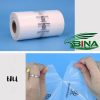
Barcode printing ink, commonly known as barcode ribbon, is a consumable for thermal transfer printers. It uses polyester (PET) film as the base material, coated with a solid ink layer made from wax, resin, or a mixture of both. The ink on the ribbon is transferred onto label paper by applying heat and pressure at the printhead, forming high-density barcode text that is resistant to scratches and abrasion.
 |
◆Learn more:
- https://hadupack.com/san-pham/in-tem-ma-vach/
- https://hadupack.com/san-pham/in-tem-bac/
- https://hadupack.com/san-pham/in-tem-nhan-trong-suot/
Composition of barcode printing ribbon ink
Barcode printing ink (such as ribbon and ink) mainly consists of colorants or dyes (carbon black, etc.), resin binders, solvents, and additives. Ribbon ink is classified into wax-based, resin-based, and hybrid types, mainly containing a polyester film substrate and thermal transfer material. UV ink contains a photosensitive diluent and photoinitiator. High-quality ink has properties such as alcohol resistance, scratch resistance, and fast drying.
 |
Detailed explanation of the components of barcode printing ink:
- Colorant (Pigment/Dye): Primarily uses carbon black to produce black, with an extremely high light absorption capacity, ensuring clear barcodes, while also providing good color fastness and water resistance.
- Resin binder: Determines the adhesion and durability of the ink.
- Wax-based ribbon: Mainly composed of wax, with a low melting point and low cost, suitable for ordinary paper.
- Resin-based ribbon: Mainly composed of polymer resin, with excellent chemical corrosion resistance and abrasion resistance, suitable for special materials such as plastic films.
- Mixed-base ribbon: A mixture of wax and resin, balancing transparency and durability.
- Solvent (fast-drying component): Used to dissolve resin and colorants, typically including alcohols (such as isopropanol) and esters (such as ethyl acetate and propyl acetate), requiring a fast drying rate and low volatility.
- Additives: Include surfactants, dispersants, defoamers and leveling agents, used to adjust the flowability and printing characteristics of the ink.
- UV ink components: Contain synthetic resin, photosensitive diluent, photoinitiator, colorant and additives, requiring curing by UV light.
- Special features: Some industrial ribbons have a special outer coating on the ink to enhance chemical resistance and scratch resistance.
 |
Main classifications of barcode ribbon:
- Wax-based ribbon: The main component is wax, with a low melting point, suitable for ordinary coated paper and hang tags, with fast printing speed and low cost, but without abrasion or solvent resistance.
- Wax/Resin-based ribbon: A mixture of wax and resin, combining high transparency and durability, with broad adaptability, used for packaging requiring a certain degree of abrasion resistance.
- Resin-based ribbon: The main component is resin, with a high melting point, scratch resistance, high-temperature resistance, and solvent resistance, suitable for smooth synthetic materials such as PET and PVC.
 |
Key features:
- High print speed: Ensures clear barcodes without pinholes, meeting scanning requirements.
- Strong adhesion: Adheres well to various materials such as paper, plastic film, and textiles.
- Ink ribbon winding direction: Available with both ink-in and ink-out configurations; the choice depends on the printer model (for example: compatibility with brands such as POSTEK and DNP).
 |
Advantages of ink ribbons for barcode printing
- Wide material adaptability (non-contact printing): Can print directly on uneven, curved, soft, or hard surfaces (such as glass, metal, paper, and plastic) without damaging the packaging, especially suitable for printing on boxes and packaging components.
- High clarity and contrast: The ink provides a high level of blackness, ensuring that the reflectance and contrast between the bars and spaces of the barcode meet ISO/ANSI standards, improving the recognition rate of barcode scanners.
- High adhesion and weather resistance: Using fast-drying ink formulated with a special substrate, barcodes are resistant to smudging, water, UV rays, and chemicals, ensuring they do not easily peel off or fade during transportation.
- High support for variable data printing: Suitable for changing serial numbers, production dates, expiration dates, QR codes, etc., in real time on production lines without replacing templates, achieving the flexibility of digital production.
- High-speed production and automation: Continuous inkjet printing technology can operate stably at extremely high production speeds, ensuring continuous operation of industrial production lines and significantly improving packaging and labeling efficiency.
 |
Storage of barcode printer ribbons
Barcode printer ribbons should be stored in a clean, dry, well-ventilated, and dark environment. The optimal ambient temperature is from 5 degrees C to 35 degrees C and the relative humidity is 20% -80%. Keep them away from heat sources, direct sunlight, and chemicals to prevent damage, melting, or reduced printing performance. They should be stored upright in their original packaging and used according to the “first in, first out” principle.
 |
Here are the specific storage requirements for barcode printer ribbons:
1. Storage environment requirements
- Temperature control: The ideal storage temperature is from 5 degrees C – 35 degrees C ( 41 degrees F – 95 degrees F). It is strictly prohibited to store ribbons in environments with temperatures exceeding 40 degrees C or under direct sunlight, as this will cause the ribbon to melt, deform, or the coating to peel off.
- Humidity control: Relative humidity should be maintained between 20%-80%. Excessive humidity will affect the chemical coating of the ribbon, thereby affecting print quality.
- Clean and dry: Store in a clean, dry, and dust-free place to avoid contamination.
2. Avoid hazardous factors
- Avoid high temperatures and strong light: Do not place near heaters, air conditioning vents, or under direct sunlight.
- Keep away from chemicals: Do not store together with solvents, chemical cleaning agents, oils, or other hazardous substances.
3. Storage Methods
- Original packaging: Keep the original plastic packaging as much as possible to prevent dust and moisture.
- Vertical storage: It is best to store ribbons upright and neatly to prevent deformation or uneven ink distribution caused by gravity from prolonged horizontal storage.
- First-in, first-out principle: Ribbons have a shelf life. Follow the first-in, first-out principle to avoid long-term storage that may result in expired ribbons.
- Following these storage guidelines can ensure the ribbon’s printing performance, extend its service life, and prevent ribbon damage.