

What is a humidity indicator?
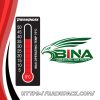
Humidity indicators are devices for measuring humidity (including thermometers and electronic hygrometers or humidity indicator cards) used to monitor the relative humidity of an enclosed space or environment to determine whether the air is too dry or too humid and decide whether dehumidification or humidification is needed. In general, the most comfortable indoor relative humidity for people should be maintained between 40% and 60%.
 |
◆Learn more:
Common types of humidity measuring device components include:
- Electronic thermometers and hygrometers: They usually have high-precision integrated humidity sensors, displaying the current ambient temperature and humidity (typically expressed as %RH) on a digital screen in real time. They are widely used in bedrooms, children’s rooms, offices, and warehouses.
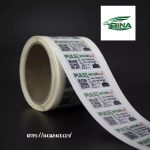
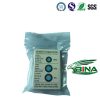
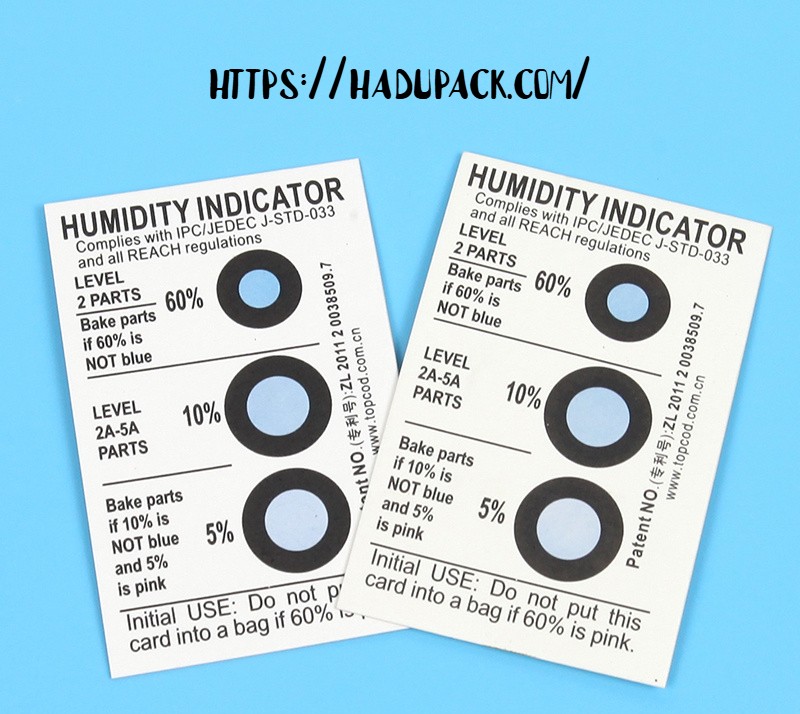
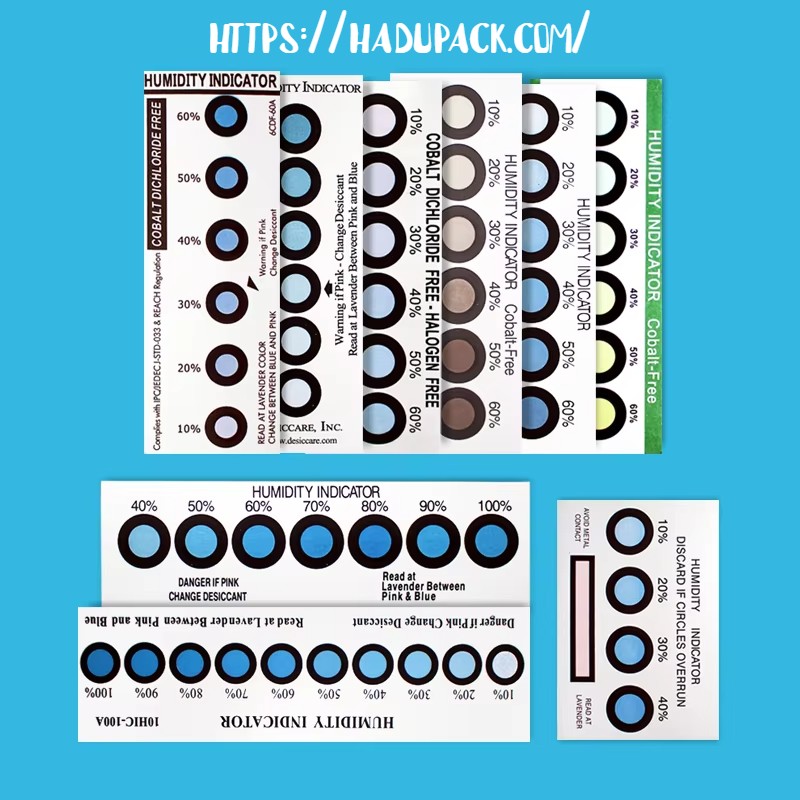
- Humidity indicator cards (HIC): They are mainly used in sealed packaging for precision instruments such as electronic products, military equipment, and semiconductors. By observing the color changes of the different percentage squares on the card (e.g., from blue to pink), one can determine with the naked eye whether the relative humidity inside the packaging is within a safe range.
 |
Principle of Using Humidity Indicator Stickers
Humidity indicator labels (or humidity cards) use the physicochemical principle of moisture absorption and color change. They are made from absorbent paper impregnated with moisture-sensitive indicator substances (such as cobalt chloride or environmentally friendly cobalt-free formulations). When the ambient humidity reaches a specific value indicated on the card, the indicator undergoes a hydration reaction, causing a change in its molecular structure and color.
1. Core principle of color change:
Take a traditional humidity card containing cobalt as an example:
- Dry state (Blue): When the relative humidity (RH) inside the package is lower than the specified value, cobalt chloride remains in its anhydrous form ([Co(H₂O)₄Cl₂]), and the indicator dot on the paper turns blue.
- Humid state (Pink): When the humidity inside the package increases and exceeds the value corresponding to the circle, cobalt chloride absorbs moisture to form hydrated cobalt chloride ([Co(H₂O)₆]²⁺), and the color changes from blue to pink.
2. Key features:
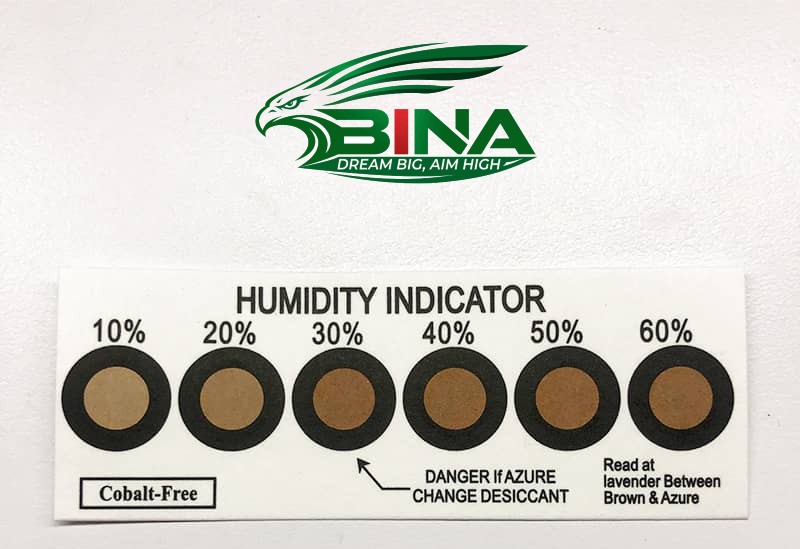
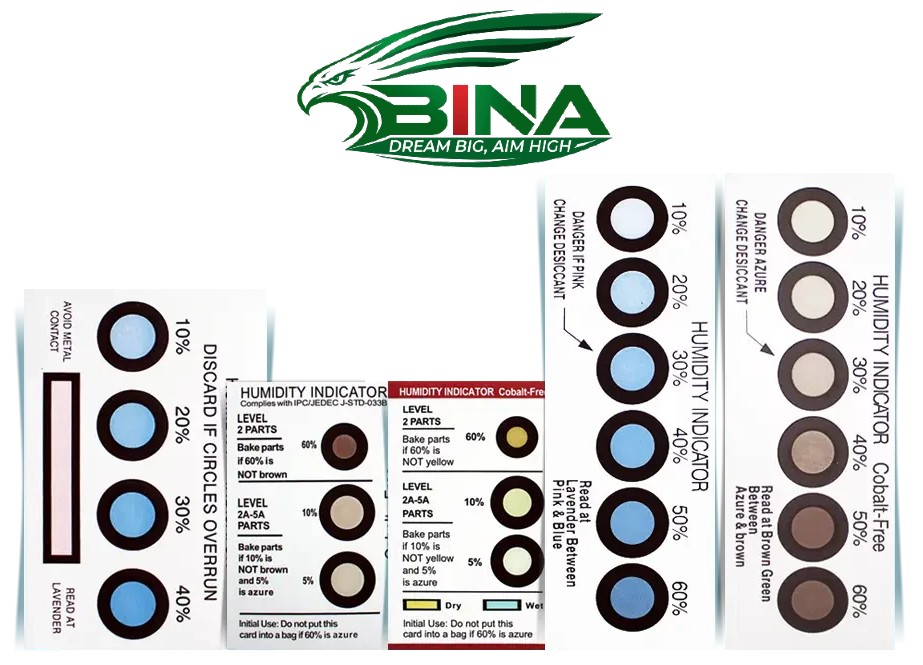
- Gradient humidity indication: The label is usually printed with multiple dots representing different percentages (e.g.: 10%, 20%, 30%, 40%, etc.) to visually display the specific humidity range in an enclosed space.
- Reversible reaction: This color change can be reversed. When the humidity inside the package or in the environment decreases (e.g.: after replacing the desiccant with an effective one), and sufficient time is allowed for the moisture to evaporate, the pink dot can turn back to blue.
 |
3. Application scenarios:
- Precision industry: Widely used in sealed packaging of semiconductors, electronic components, optical instruments, and metal products to monitor whether the internal environment is safe and moisture-proof.
- Warehousing and logistics: Can be used with desiccants; by checking the color of the indicator label, it can be determined whether the desiccant has expired and needs to be replaced.
4. Usage precautions:
- Avoid direct contact: Human sweat contains moisture and salt; direct contact with the indicator dot will cause the label to change color, affecting accuracy.
- Limit exposure to air: To ensure accurate measurement, after removing the label, the product should be placed in transparent, airtight packaging as soon as possible.
 |
Instructions for using humidity indicator labels (adhesive indicator stickers)
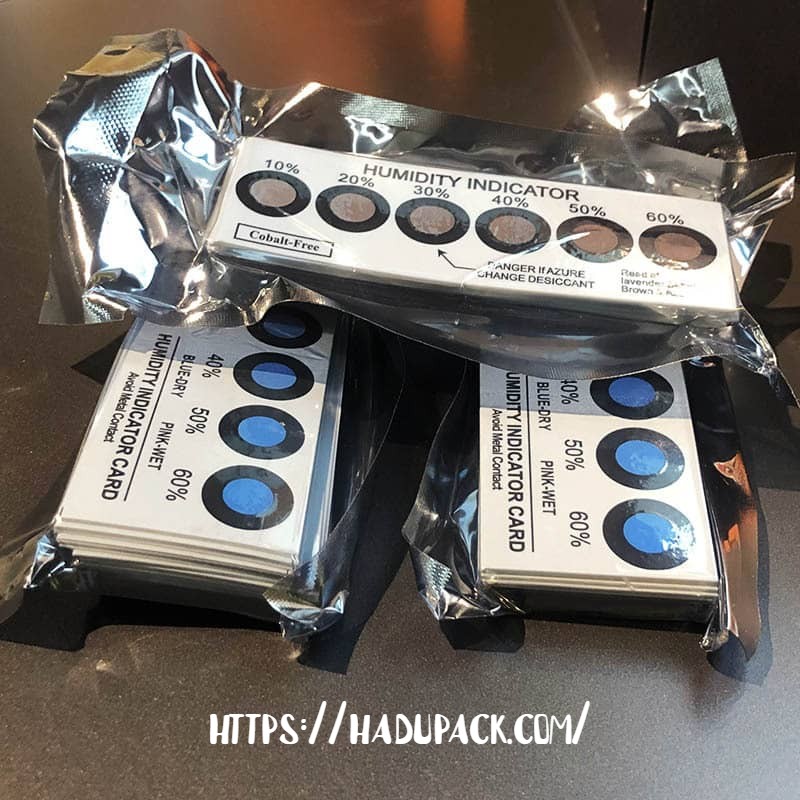
Humidity indicator labels (also known as humidity indicator cards) are used to monitor relative humidity in an enclosed space or package. To use them, place them in a sealed bag together with a desiccant; observe whether the indicator color changes from the dry color (e.g.: blue) to the moisture-absorbing color (e.g.: pink) to determine whether the environment inside is safe. Instructions for use and explanation:
- Place the products: Place the items to be stored and the desiccant in a sealed bag or container, and add the humidity indicator card.
Observe: After sealing, wait about 1 hour for the environmental humidity to stabilize. - Color interpretation: If the indicator ring shows the dry color (e.g.: blue/brown), the environment is dry and safe. When the humidity reaches or exceeds a specific threshold, the color inside the corresponding ring will reverse (e.g.: change to pink/blue), indicating that the environment is humid. It is recommended to replace the desiccant according to the specific instructions on the label or the evaluation criteria.
 |
⚠️ Note: Avoid touching by hand:
Use tweezers to handle the label; Do not touch the indicator ring directly with your fingers to prevent sweat from affecting the measurement results.
- Work quickly: Seal the packaging as soon as possible after opening. If the indicator card changes color after being exposed to air for more than 30 seconds, it must be dried before reuse.
- Shelf life: Unused indicator cards should be stored in the original packaging and sealed in a dry, cool, well-ventilated place.
You can refer to the product specifications of BiNa Vietnam Joint Stock Company to understand the specific color-change range and accuracy of different types of labels. If you can provide the brand of the indicator label or the humidity specifications on the packaging (for example: 10%, 30%, 60%, etc.), I can help you confirm the specific safe humidity standards and recommend product storage conditions.
⚠️ Note: Avoid touching by hand:
Use tweezers to handle the label; Do not touch the indicator ring directly with your fingers to prevent sweat from affecting the measurement results.
- Work quickly: Seal the packaging as soon as possible after opening. If the indicator card changes color after being exposed to air for more than 30 seconds, it must be dried before reuse.
- Shelf life: Unused indicator cards should be stored in the original packaging and sealed in a dry, cool, well-ventilated place.
You can refer to the product specifications of BiNa Vietnam Joint Stock Company to understand the specific color-change range and accuracy of different types of labels. If you can provide the brand of the indicator label or the humidity specifications on the packaging (for example: 10%, 30%, 60%, etc.), I can help you confirm the specific safe humidity standards and recommend product storage conditions.