

Description
What is transparent label printing?
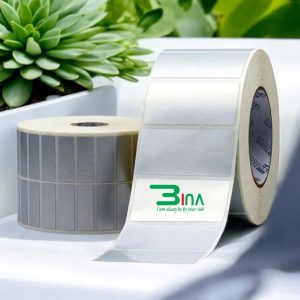
Transparent label printing is a printing technology that uses transparent BOPP, PET, or PE plastic film as the substrate, featuring water resistance, abrasion resistance, and high transparency. Colored images or text are printed directly onto this transparent substrate, often combined with white ink printing technology beforehand to enhance color saturation, creating a “no-label” visual effect when the image is printed directly onto the product packaging. This technology is commonly used for cosmetic packaging, daily consumer chemical products, and food bottle packaging.
 |
◆Learn more:
- https://hadupack.com/san-pham/tem-nhan-duoc-pham/
- https://hadupack.com/san-pham/in-tag-quan-ao/
- https://hadupack.com/san-pham/in-tem-nhan-cuon/
Structure of transparent labels
Transparent labels (stickers) usually consist of four layers: the outermost layer is the printed ink (containing white ink to make the colors stand out), underneath is the transparent PET/BOPP substrate (providing transparency and durability), the middle layer is the adhesive layer (for attaching to the container), and the bottom layer is the release liner. High-quality transparent labels often combine “PET material + white ink + colored ink” to create a “no-label” visual effect.
 |
Detailed structural analysis:
- Top printing layer: Printed content, typically using UV ink. To ensure that text or images are displayed clearly on transparent materials, a layer of white ink is usually printed first, followed by the colored content.
- Transparent substrate layer: Mainly made from PET (polyester), BOPP (biaxially oriented polypropylene), PVC or PE, etc., with high transparency and chemical stability.
- Adhesive layer (adhesive): Used to bond the label to the object; it can be a permanent adhesive or a removable adhesive that leaves no residue.
- Release liner (backing paper): A protective layer covering the adhesive surface and supporting the printing process; this layer is peeled off before use.
This structure is commonly used on bottles for daily chemicals, food and wine, creating an effect where the text appears to be printed directly onto the bottle.
 |
Transparent label printing production process
The production of transparent printed labels mainly includes design and layout, material selection (PET/PP/PVC), printing (usually with additional white ink), surface treatment (lamination/hot stamping), die cutting, waste removal, and finished product inspection. The key lies in using white ink as a base layer on transparent materials and high-precision overprinting technology to ensure vibrant colors and a refined appearance on the transparent background.
 |
The specific production process is as follows:
- Design and pre-print preparation: Design the artwork according to the customer’s requirements, set up four-color CMYK and a white ink layer, create printing plates (offset printing) or prepare electronic files (digital printing).
- Material selection and machine preparation: Select transparent PET, PP, or PVC self-adhesive materials (PET usually has the highest transparency). Load the material roll into the machine according to the printing method (rotary press, flexographic press, digital printer).
- White ink base layer (Basic Step): Due to the transparency of the material, a layer of white ink is usually applied to the areas where the design will be printed before color printing to prevent the underlying color from showing through and make the colors more vibrant.
- Color printing: The four-color CMYK design is printed on the white ink base, often combined with screen printing or high-speed flexographic printing to make the label image sharper.
- Surface treatment: To protect the transparency and design, a glossy or matte film can be applied to the surface, or embossing (gold/silver) can be used to increase the texture.
- Die-cutting and waste removal: The printed transparent film is die-cut into specific shapes using die-cutting blades, and the excess waste is removed.
- Inspection and slitting: The transparency, color differences, and die-cutting accuracy of the labels are inspected. Defective products are removed by an inspection machine, and finally, the labels are slit into finished rolls or individual sheets.
 |
Main features of transparent labels:
- High transparency and near-invisibility: Crystal-clear plastic material that highlights the content underneath.
- Waterproof and crease-resistant: The material has excellent water-, oil-, and crease-resistant properties.
- White ink base layer: To address the issue of faded colors on transparent materials, a layer of white ink is usually printed first to ensure clear and vivid images.
- High adhesion and versatility: Suitable for application on smooth surfaces such as glass and plastic; long-term stability can be achieved through special adhesives.
 |
Common application areas:
- Daily chemicals: Transparent shampoo bottles, hand sanitizer bottles.
- Food and beverages: Transparent beverage bottles, glass pickle jars, wine labels.
- Cosmetics: Transparent body lotion bottles, mask packaging.
- Advertising labels: Partially sealed labels or window stickers that emphasize transparency.