



Description
What is a desiccant?
Desiccants are substances that absorb moisture from the surrounding environment, primarily used to control humidity and prevent products from becoming moldy, oxidized, or damaged. They are commonly used in food, pharmaceuticals, electronics, and the storage of shoes/handbags. Based on their operating principles, they are divided into two types: “physical adsorption” and “chemical reaction”. Common ingredients include silicon and quicklime.
 |
☞See more:
- https://hadupack.com/san-pham/hat-hut-am-clay/
- https://hadupack.com/san-pham/tui-chong-am-container/
- https://hadupack.com/danh-muc/hat-chong-am/
Types and main characteristics of desiccants:
Hadupack introduces to valued customers the common types of desiccants:
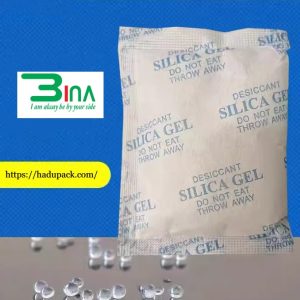
Silica gel desiccant (Physical):
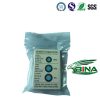
- Characteristics: Small, round, transparent beads (sometimes blue when cobalt chloride is added, turning pink after absorbing moisture), relatively safe, non-toxic, odorless and capable of absorbing approximately 40% of its own weight in water.
- Uses: Commonly used in food, pharmaceuticals and electronic machinery.
- Advantages: Stable structure, not easily chemically altered after absorbing moisture, environmentally friendly and can be regenerated by heating.
 |
Calcium oxide desiccant (CaO, quicklime) (Chemistry):
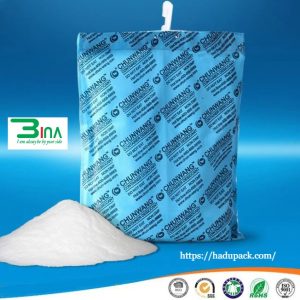
- Characteristics: White lumps, which turn into powdered calcium hydroxide (slaked lime) after absorbing water.
- Uses: Highly effective desiccant, commonly used in photographic equipment, camera dehumidifiers, leather goods, clothing, etc.
- Disadvantages: Strongly alkaline, not edible, reacts with water; must be stored carefully.
Montmorillonite/Mineral Desiccant (Physical):
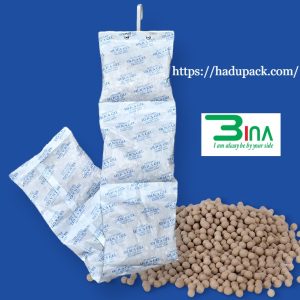
- Characteristics: Made from natural montmorillonite minerals, using physical adsorption, very safe, suitable for electronic products and machinery.
- Not edible: Keep out of reach of children, regardless of the type of desiccant.
- Avoid moisture: After opening, the desiccant will absorb moisture from the outside, becoming a source of moisture and accelerating the deterioration of the items inside. It is recommended to remove the desiccant after opening.
- Do not heat: Do not put quicklime-based desiccants in the microwave or heat them to avoid danger.
 |
Desiccant Production Process
Desiccant production processes are mainly divided into physical adsorption types (such as silica and minerals) and chemical reaction types (such as quicklime and calcium chloride) based on the materials used. Industrial production processes typically include raw material processing, shaping, activation drying, and packaging. The key to silica production is the reaction of water glass with acid to form a gel, followed by washing and drying.
1. Production process of physical adsorption desiccants (Silicone/Silica Gel)
- Raw material preparation: Sodium silicate (liquid glass) is used as the main raw material.
- Gel formation: Acidic substances such as sulfuric acid are added to react with liquid glass and form hydrogel.
- Washing and aging: Impurities generated during the reaction (reaction water and solution water) are washed away; this stage controls the pore structure of the gel.
- Drying: Drying is carried out at a high temperature of 100-400°C to form porous silicon particles capable of absorbing moisture.
 |
1. Color-changing treatment (Optional):
Add cobalt chloride (from blue to red) or environmentally friendly indicators (such as from orange to green) to indicate the water saturation status.
2. Production process for chemical reaction-type desiccants (quicklime):
- Raw materials: Calcium carbonate (limestone) is calcined at high temperatures. Production: (CaCO3 → CaO + CO2) produces lump-form calcium oxide (quicklime).
- Processing: It is crushed and sieved to control particle size, and packaged quickly to prevent moisture absorption and deterioration.
3. Special desiccant processes:
- Mixed desiccant: Iron powder, sodium chloride, bentonite, activated carbon, etc. are mixed together and then a binder is added to form the mixture. Commonly used for high-speed moisture absorption.
- Desiccant sheets: Calcium chloride solution is impregnated into absorbent paper or fibrous materials, then dried and formed.
- Desiccant granules: Desiccant materials are mixed with resin and extruded into granules.
- Suitable for plastic packaging.
4. Packaging process:
- Packaging materials typically used are those with high moisture absorption, good sealing properties, and low dust generation (such as Tyvek).
- Automatic packaging machines are commonly used to perform feeding, packaging, sealing, and inspection (such as metal detection) to produce the final desiccant packets.
 |
Common Problems in Desiccant Production
In the production of desiccants (such as silica gel, mineral-based desiccants, and lime), common problems mainly focus on insufficient moisture absorption capacity, packaging sealing, production environment control, and product quality consistency. The following is a summary of common problems and challenges in desiccant production:
1. Raw Material and Performance Issues:
- Insufficient moisture absorption capacity: Uneven pore structure or insufficient activation of raw materials (such as silicon particles or mineral clay) results in moisture absorption capacity below the standard.
- Desiccant deactivation: During the manufacturing and packaging process, the material may be exposed to excessive moisture, leading to a significant reduction in moisture absorption capacity when it leaves the factory.
- Uneven particle size: Affects filling speed and weight stability.
3. Production environment control issues:
- Excessively high humidity in the workshop: If the production environment is not dried, the desiccant will absorb moisture from the air before packaging.
- Improper operation: Employees may not wear appropriate protective clothing, or raw materials may be exposed to the air for too long.
4. Production challenges by product type:
- Safety and reactivity of lime desiccant (calcium oxide): Lime releases heat and produces a strong alkali when in contact with water. If the production environment is damp or moisture gets mixed into the raw materials, an exothermic reaction may occur, potentially leading to packaging rupture or burns to workers.
- Managing color changes of colored silicone: Indicator silicone (for example: from blue to pink, from orange to dark blue) may exhibit inconsistent color changes if exposed to moisture during manufacturing, making quality assessment difficult.
5. Quality sampling issues:
Inaccurate weight and saturation testing: Some desiccants (e.g., mineral-based) do not show obvious changes in appearance after absorbing moisture; accurate weight sampling is required to determine compliance.
- Proposed production improvement plan: Strict environmental control: The production workshop should be equipped with dehumidifiers and should use packaging materials with good sealing properties (for example: waterproof and breathable DuPont paper).
- Upgrade sealing technology: Ensure uniform temperature and pressure in automatic sealing machines and regularly check sealing strength.
- Seal finished products immediately: After producing desiccants, they should be sealed immediately in vacuum packaging to minimize exposure to air.
 |
Tips for Choosing Desiccants
The key factors in choosing a desiccant are its intended use, environmental humidity, and safety. For food/pharmaceutical products, non-toxic materials such as silica gel or montmorillonite should be used; for electronic products, materials with high absorption capacity (such as molecular sieves) are suitable, and for wardrobes, calcium chloride with a long-lasting effect should be used. Some important tips include: calculating the dosage based on the packaging size, prioritizing environmentally friendly and biodegradable materials, and choosing airtight packaging. Below are detailed tips for choosing:
1. Choose the type based on the application scenario:
- Food and pharmaceuticals: Safety comes first; it is recommended to choose blue or orange color-changing silica desiccants (which make it easy to identify when they have deteriorated) or natural montmorillonite desiccants.
- Electronic products and precision instruments: Strong moisture absorption without releasing moisture is required; molecular sieves or silica should be used to protect sensitive components.
- Wardrobes and shoe cabinets: Spacious and humid areas; calcium chloride desiccants with high moisture absorption capacity are recommended, commonly available in boxes or bags, which turn into liquid after absorbing moisture.
- Long-term storage/containment: Use highly effective mineral desiccants or specialized moisture-absorbing sticks, which are durable and have a high moisture absorption rate.
 |
2. Choose products with high moisture absorption capacity (e.g.: calcium chloride) based on their hygroscopic properties:
- Suitable for environments with high humidity, absorbing up to 300% of their own weight in water, but usually only used once.
- High accuracy/reusable (e.g.: silicon): Physical adsorption; after saturation, it can be dried by heat and reused, economical and environmentally friendly.
3. Pay attention to important details and the safety of the ingredients:
- Avoid choosing low-quality products containing dimethyl fumaric acid to ensure they are not toxic to humans.
- Packaging material: Choose breathable packaging that does not leak powder, such as nonwoven fabric or composite paper packaging.
- Expiration indicator: Prioritize color-changing silica gel; it can be replaced when the color changes from blue to pink (or orange to green), providing a visual and accurate indication.
4.Tips for specific cases:
- Pharmacists recommend discarding the desiccant inside dietary supplement bottles immediately after opening to prevent it from absorbing moisture from the outside and causing the medicine to spoil.
- Regular replacement recommendation: In general, it is recommended to replace the desiccant in household drawers every 2-3 months, while in damp shoe cabinets it should be replaced every 1-2 months.
 |
Mẹo bảo quản chất hút ẩm
Để kéo dài tuổi thọ của chất hút ẩm (đặc biệt là những chất chưa sử dụng sau khi mở), điều quan trọng là phải “ngăn không khí” và “bảo quản chúng ở nơi khô ráo, thoáng mát”. Dưới đây là một số mẹo bảo quản chất hút ẩm chưa mở và đã mở:
1. Bảo quản chất hút ẩm chưa sử dụng sau khi mở:
- Chất hút ẩm bắt đầu hấp thụ độ ẩm sau khi mở, vì vậy chúng phải được niêm phong ngay lập tức:
- Máy niêm phong: Cho chất hút ẩm chưa sử dụng trở lại túi đựng và niêm phong lại bằng máy niêm phong.
- Hộp/Túi kín: Cho chất hút ẩm vào hộp nhựa, chai thủy tinh hoặc túi hút chân không được niêm phong kỹ và ép hết không khí ra ngoài càng nhiều càng tốt.
- Bảo quản chân không: Cách tốt nhất là sử dụng túi hút chân không hoặc hộp được niêm phong chân không, giúp tối đa hóa thời hạn sử dụng.
- Ghi nhãn ngày tháng: Ghi nhãn bên ngoài hộp kín với ngày mua hoặc ngày mở để dễ dàng nhớ lại.
2. Yêu cầu về môi trường bảo quản:
Bảo quản ở nơi khô ráo, thoáng mát, tránh ánh nắng trực tiếp và ở nhiệt độ thích hợp, chẳng hạn như ngăn kéo hoặc tủ.
- Tránh nhiệt độ và độ ẩm cao: Hãy nhớ không đặt nó trong nhà bếp, phòng tắm hoặc gần cửa sổ có ánh nắng trực tiếp.
- Cách nhiệt mặt đất: Đối với việc lưu trữ quy mô lớn, không đặt chất hút ẩm trực tiếp trên mặt đất. Sử dụng khay hoặc tấm nhựa để ngăn chặn sự dẫn nhiệt từ mặt đất.
- Tránh tường: Giữ khoảng cách từ 0,3 đến 0,5 mét so với tường và cột để đảm bảo thông gió.
 |
3. Cách xác định chất hút ẩm không hiệu quả:
- Chất hút ẩm silicon: Khi chất chỉ thị chuyển từ màu xanh lam sang màu hồng, hoặc màu cam sang màu xanh đậm, điều đó cho thấy chất hút ẩm đã bão hòa và nên được loại bỏ ngay lập tức.
- Chất hút ẩm vôi: Nó không hiệu quả khi bao bì phồng lên rõ rệt và chất bên trong không còn ở dạng hạt mà đã chuyển thành dạng bột.
4. Mẹo đặc biệt đối với hộp đựng thực phẩm chức năng:
- Nếu chất hút ẩm nằm ở miệng chai (lớp trên cùng), nên loại bỏ nó sau khi mở, vì việc mở và đóng nhiều lần sẽ khiến nó mất hiệu quả và dễ bị nhiễm bẩn. Tuy nhiên, nếu nó nằm ở đáy chai, có thể giữ lại.
- Không cần bảo quản lạnh: Trừ khi có chỉ dẫn cụ thể, không nên để chất hút ẩm hoặc thực phẩm trong tủ lạnh, vì sự thay đổi nhiệt độ liên tục sẽ gây ngưng tụ và hấp thụ độ ẩm mạnh hơn.
Tóm tắt: Tránh tiếp xúc với không khí là điều quan trọng. Nếu không sử dụng hết chất hút ẩm, cần phải niêm phong kín để ngăn ngừa việc hấp thụ độ ẩm và mất tác dụng trong quá trình bảo quản.
Thông tin chi tiết về Hadupack chúng tôi
 |