



Description
What is a steel strapping buckle?
A steel strapping buckle, also known as a packaging steel strap buckle (or strapping buckle), is a specialized buckle used to secure the two ends of packaging straps. They are widely used in industrial transportation and logistics to strap and package steel, wood, cartons, and large goods.
 |
Made of stamped metal, cast metal, or plastic, they rely on their own structure or dense internal teeth to grip the straps firmly, providing anti-slip properties and increasing tensile strength at the connection point. They are a core component for securing cargo safely.
 |
Structure of steel strapping buckles
Steel strapping buckles (packaging buckles) are typically made of high-strength steel through stamping or casting. Their core structural design is intended for locking and securing. Structurally, they usually consist of a main buckle body and internal anti-slip teeth (or sharp teeth), with some designs using a hollow frame structure. During operation, the teeth engage with the steel strap, using high pressure to generate mechanical locking force to withstand high tension and prevent slipping.
 |
 |
◆Learn more:
- https://hadupack.com/san-pham/dung-cu-siet-day-dai-nhua/
- https://hadupack.com/san-pham/dung-cu-siet-day-dai-thep/
- https://hadupack.com/san-pham/day-dai-in-logo/
The specific structural features are as follows:
- Lock body: Primarily a U-shaped or frame structure, used to thread through and cover the two layers of steel strapping.
- Dense teeth/Sharp teeth: Small sharp teeth located inside the lock body, mainly functioning to firmly grip the steel strapping, prevent slipping, and increase tensile strength at the joint.
- Locking method: After the steel strapping is inserted into the lock body, a tool is used to flatten the lock body, causing the anti-slip teeth to firmly engage with the strapping.
- Self-locking function: For steel strapping bundles, an automatic locking mechanism using pressing blocks, locking blocks, and springs is commonly used (often found in some high-end automatic strapping machines). This design is used to connect and secure steel strapping in industrial and transportation applications.
Packaging buckles are used to join the two ends of strapping. Structurally, they typically use metal buckles or iron packaging buckles, with anti-slip teeth on the inside to ensure the strength of the joint.
 |
Classification of steel strapping buckles, steel strapping seals
Steel strapping buckles (metal buckles used for packaging straps) are mainly divided into push-type, open-type, semi-open and clamp/box-type. According to material and application, they are further divided into cold-rolled galvanized steel buckles, anti-slip buckles with teeth and “M”-shaped buckles (steel strapping buckles) used for fiber/plastic strapping, mainly serving the functions of sealing, connecting and enhancing tensile strength. The specific classification is as follows:
 |
According to structural shape:
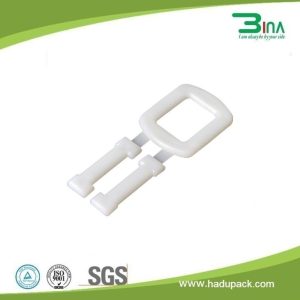
- Open (Common): Horsehoe-shaped, can be directly clamped onto two straps, allowing quick operation.
- Push (Closed): Formed into a closed rectangle, must be inserted into the strap before packaging, providing better fastening strength.
- Clip/Box: Mainly used in continuous automatic packaging tools to improve work efficiency.
Steel strapping buckle (M-shaped/U-shaped buckle): Suitable for flexible fiber packaging straps, secured by wrapping the rope.
 |
According to the anti-slip treatment method:
- Spiked/anti-slip buckle: Dense spikes on the inside enhance anti-slip performance.
- Smooth buckle: Smooth surface.
According to material and surface treatment:
- Galvanized iron buckle: The most common, with good rust resistance, suitable for most industrial packaging.
- Stainless steel buckle: Designed for highly corrosive environments, with high durability.
- Common specifications (width): 16mm, 19mm, 25mm, 32mm, etc., and must match the appropriate strapping specifications.
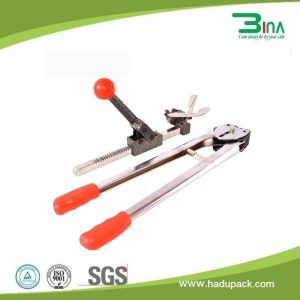
Steel strapping buckles generally require specialized strapping machines and clamping pliers; currently, some applications are gradually being replaced by heat welding technology.
 |
Applications and core features:
Steel strapping seals and buckles are essential for securing heavy, high-tension loads in industrial, shipping, and construction applications. They provide permanent, high-strength fastening for materials such as metal coils, scaffolding, and pipes, or for securing large, heavy pallets for transport. These components ensure maximum load stability against corrosion and physical stress.
 |
- Daily Applications: Plastic buckles are commonly used to secure nylon straps in outdoor sports equipment (such as backpacks and tents).
- Heavy-Duty Packaging & Shipping: Securing heavy loads on pallets and inside containers, including machinery, construction materials, and metal, especially with high-tensile-strength steel strapping.
- Pipe and Cable Bundling: Using stainless steel strapping and buckles to secure conduits, utility poles, and marine-related infrastructure (e.g., boats, mines).
- Construction and Infrastructure: Tightly bundling steel bars, reinforcing steel, lumber, and other heavy construction materials.
- Industrial Securing: Securing large industrial components, such as furnaces or heavy containers, for domestic and export transportation.
- Solar System Installation: Using corrosion-resistant stainless steel strapping and clamps to secure components in solar arrays.
Types and Functions:
- Open/Press Buckles (Clamps): Applied to the ends of straps, ideal for compression packaging and heavy-duty load bundling.
- Closed/Press Buckles: Threaded onto the strap before tensioning, used in various industrial settings.
- Stainless Steel Buckles: Used with strapping for superior corrosion resistance in harsh, humid, or marine environments.
 |
Instructions for using steel strapping buckles
Metal strapping buckles are used to secure poly or composite strapping by threading the strap through the buckle, wrapping it around the package, and tightening it by hand or with a strapping tensioning tool. They provide a reliable fastening method with high tension. Use metal strapping buckles for heavy-duty packaging and with suitable strapping tools to achieve maximum tension.
 |
Thread the strap through the buckle
- Initial loop: Thread the strap up through the middle of the buckle, loop it around one buckle leg and pull tight.
- Wrap and repeat: Wrap the strap around the package and thread the strap end up through the middle of the buckle once again, looping it around the other buckle leg.
- Ensure the correct direction: The strap must be secured tightly around both buckle legs to prevent slipping.
Tension and secure
- Manual tensioning: Pull the loose end of the strap tight to secure the goods.
- Using a tensioning tool: For higher tension, use a strap tensioner to pull the strap, then cut off the excess.
- Alternative: Some users may use a screwdriver to remove the excess strap.