



Description
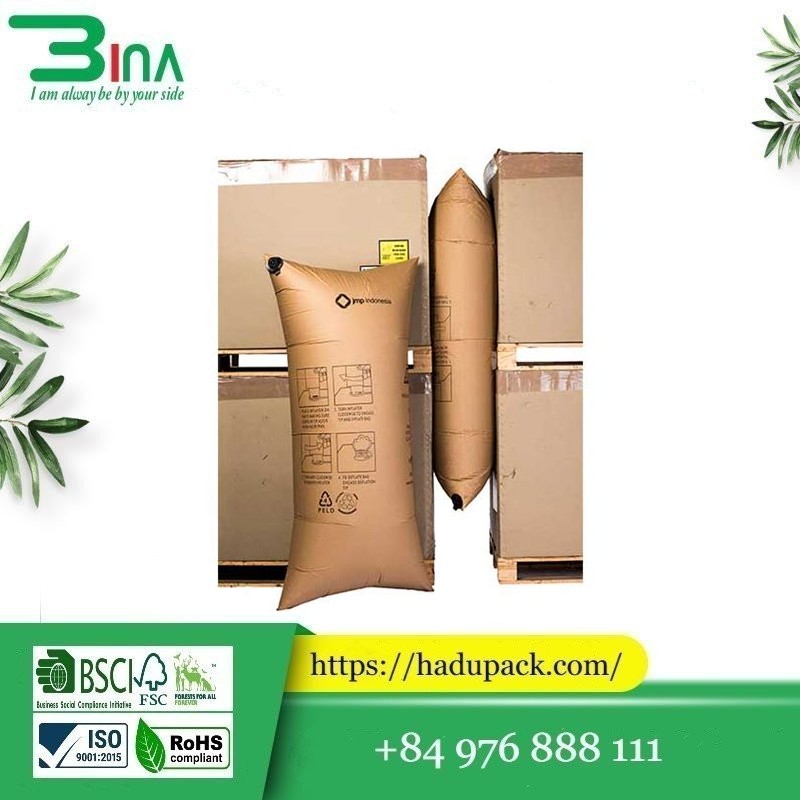
What are container cargo dunnage air bags?
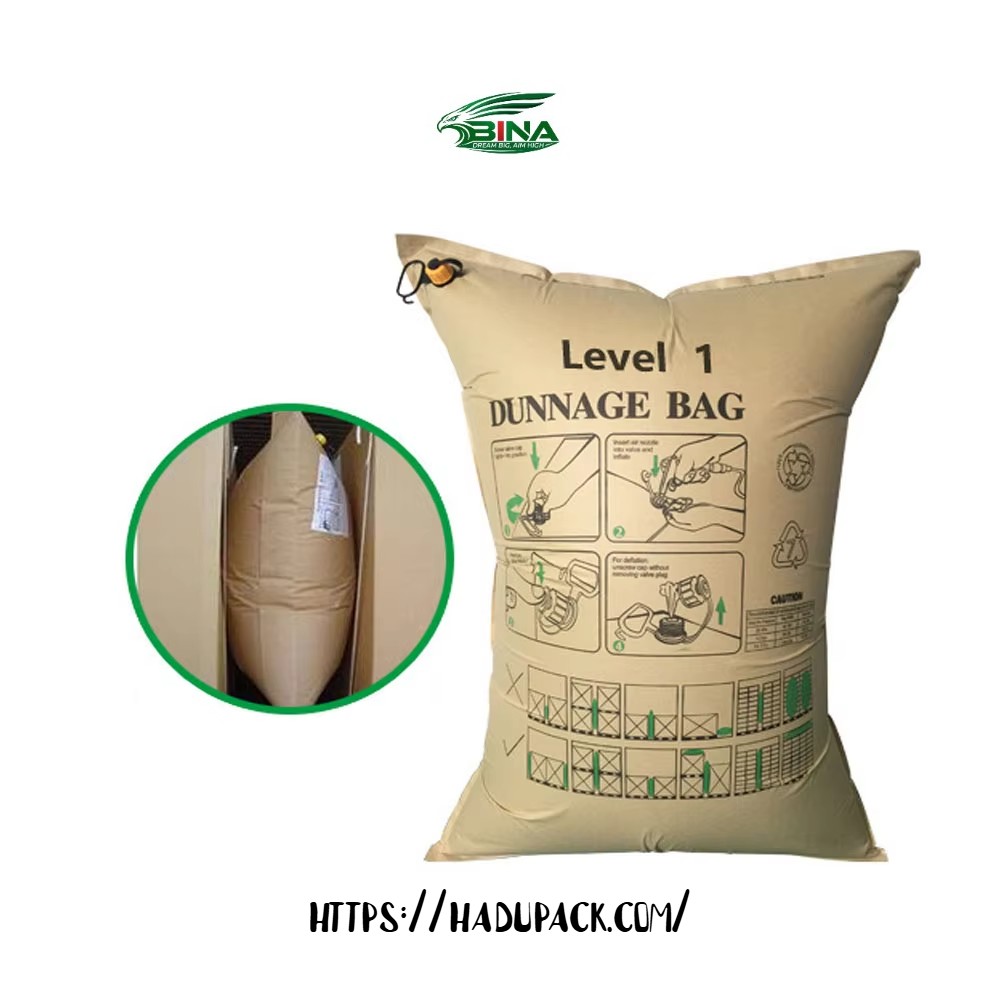
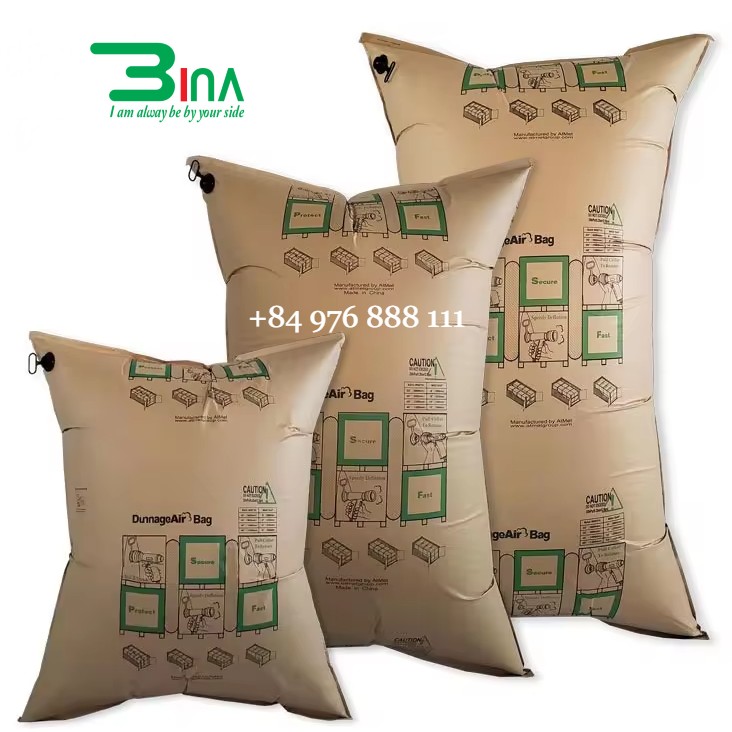
Container cargo dunnage air bags (also known as inflatable bags/cushion bags) are inflatable packaging materials used to secure and protect goods during transportation. Placed between cargo spaces, they are inflated to fill gaps, reduce vibration, and prevent impacts and movement. They are widely used in sea, road, and rail transportation.
 |
Uses of inflatable bags and air dunnage bags for container cargo
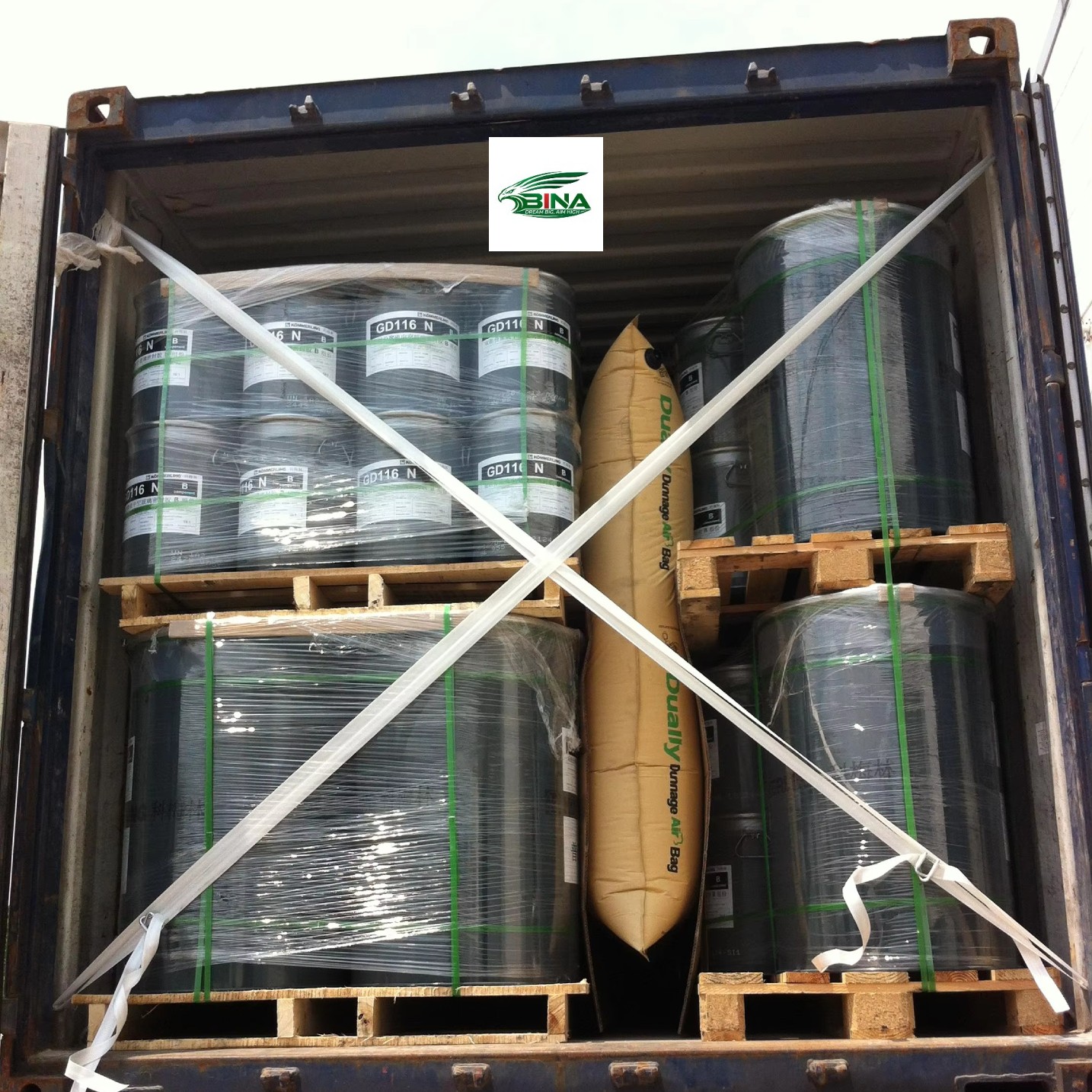
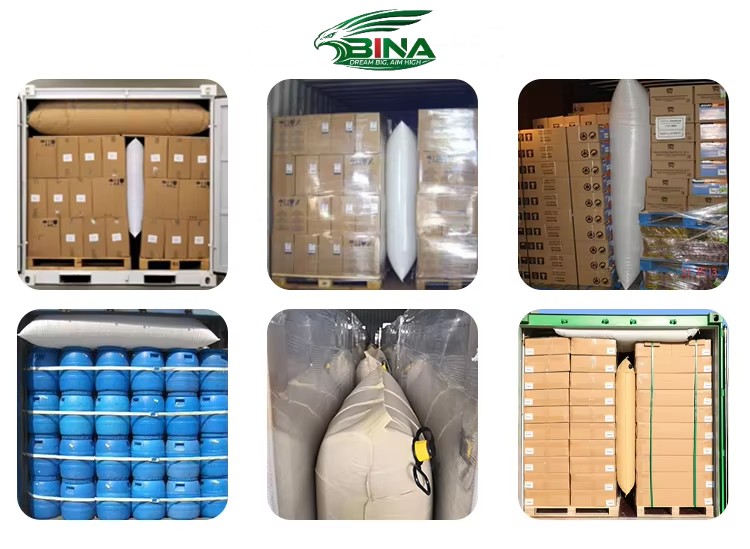
Container air dunnage bags have many applications and are basically used in all large-scale transport packaging fields, such as machinery and equipment transportation, the container transport industry, trucks, containers, freight trucks, logistics transportation, box trucks, railway transportation, road transportation, maritime transportation, etc … After all, they have many features, including filling, positioning and preventing movement, securing and impact resistance, anti-tilting, anti-extrusion, vibration resistance, shock resistance, drop resistance, breakage resistance and loss prevention They have the following six important functions.
 |
 |
◆Learn more:
- https://hadupack.com/san-pham/giay-chong-gi-vci/
- https://hadupack.com/san-pham/giay-chong-am/
- https://hadupack.com/san-pham/giay-ivory/
Container dunnage air bag production process
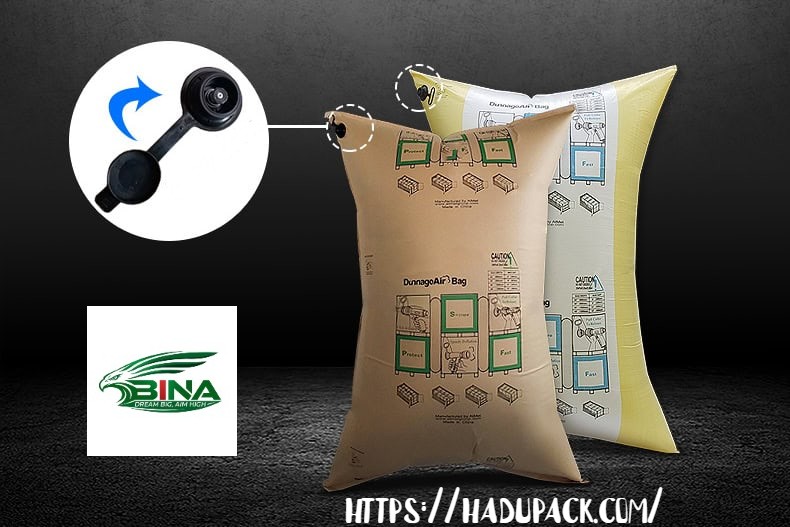
Container air bags (inflated air bags) are mainly manufactured using high-strength PP woven fabric or kraft paper composite materials, combined with an inner sealing plastic film and heat-welded. The core process includes film lamination, cutting, heat welding, installation of specialized inflation valves, and high-pressure testing. They are characterized by high strength, ease of use, and excellent sealing performance.
1. Container air bag production process
Container air bags generally have a two-layer or multi-layer structure, requiring extremely high production standards. The main steps are as follows:
- Material preparation and lamination: The outer layer uses high-strength polypropylene (PP) woven fabric or high-strength kraft paper to withstand compression and tearing forces. The inner layer uses multilayer nylon composite film or PE film to ensure sealing and explosion resistance. Lamination technology is commonly used to bond the outer material to the inner film.
- Precision cutting: According to the designed dimensions, an automatic cutting machine cuts the laminated material into specific shapes (usually squares or rectangles) for subsequent heat welding.
- High-temperature heat welding: This is a critical step. Using a high-frequency heat welding machine or heat press, the outer composite fabric and inner plastic film are hermetically welded under high temperature and pressure to form a seamless seal, ensuring that the air bag does not leak or burst under pressure.
- Inflation valve installation: Holes are drilled at specific positions on the air bag (usually at the corners or center), and a specialized integrated self-locking inflation valve is installed. This valve requires excellent sealing performance and must automatically lock after inflation to prevent air from flowing back.
- Strength and quality inspection: Finished air bags undergo inflation testing, usually including simulated pressure testing to verify their resistance to bursting, abrasion resistance, and airtightness under high pressure.
 |
2. Core production technology factors
Composite materials: Woven PP fabric + inner film (improves tear and compression resistance), kraft paper + PE film (environmentally friendly and provides good shock absorption and cushioning).
Valve technology: Specialized rapid inflation valve, supporting repeated operation, with a one-way valve function. Pressure resistance: The sealing technology must ensure that the airbag can withstand at least or higher internal pressure to cope with the movement of goods during transportation.
3. Product features
- Protective performance: Fills gaps between goods to prevent shifting and damage during transportation.
- Environmentally friendly materials: Many products are made from recyclable kraft paper or environmentally friendly PP materials.
- Multiple specifications: Designed according to container dimensions and loading and unloading requirements (see 20-foot containers, 40-foot containers).
 |
Features of container inflatable bags
1. Goods are secured and positioned to prevent shifting and impact.
When packing goods onto trucks, we often encounter some unfilled gaps. Filling the gaps with appropriately sized container bags can effectively secure the position, prevent movement and collisions from the front, rear, left, and right, and ensure that the goods are transported safely, minimizing damage caused by collisions and scratches to valuable items in the box.
2. Anti-extrusion, shock-resistant, elastic recovery.
During transportation, bumps and vibrations are inevitable, causing compression and shaking; when secured with dunnage bags, they can prevent vibration and compression, which may cause deformation, loosen items, and damage the dunnage bags, etc.; when inflated, they can withstand multiple heavy loads and have elastic recovery, which can effectively secure the goods and ensure their safety once again.
 |
 |
3. Shockproof, drop-proof, breakage-proof and loss-proof
When the box is full and the goods are stacked on top of each other, the goods will shake and fall during transportation. When using container bags, filling and cushioning are carried out to protect the goods from damage.
4. Reduce damage costs
Because container inflatable bags have better cushioning elasticity and reset capability, they ensure the safety of the goods, thereby reducing losses caused by damage during transportation and reducing transportation costs.
 |
 |
5. Transportation costs
Container bags are filled with air and are naturally lightweight. Vehicles should be easier to move and consume less fuel. The air bags themselves are lightweight, which can effectively reduce transportation costs (such as air freight).
The bag is a thin piece before inflation compared with other filling materials, takes up less space, and has higher inventory utilization efficiency.
6. Improve efficiency
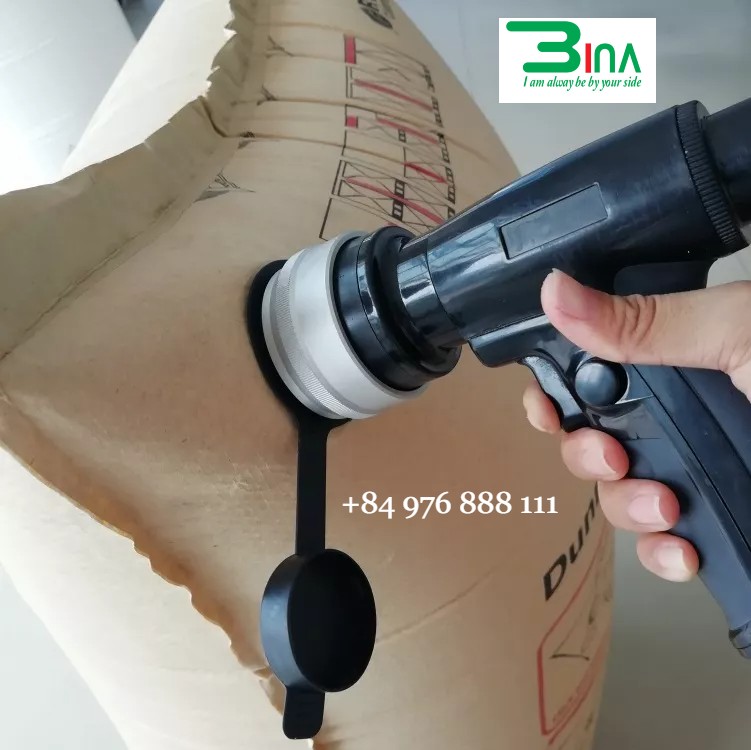
- Time: Using container bags for filling is clearly much faster in terms of time. Previously, some people used other items for filling, which took a lot of time, such as filling tires, not to mention the relatively high cost of purchasing tires to fill. If you want to find a filler of a suitable size for the gap, you have to move the goods frequently, which is very time-consuming and useless.
- Labor: If using other fillers, you have to find a filler of a suitable size. In many cases, someone is needed to secure and assist with loading and filling, which wastes manpower if using container bags. One person can load and fill the goods. The work can be completed quickly, improving work efficiency.
 |
 |
Classification of container dunnage air bags
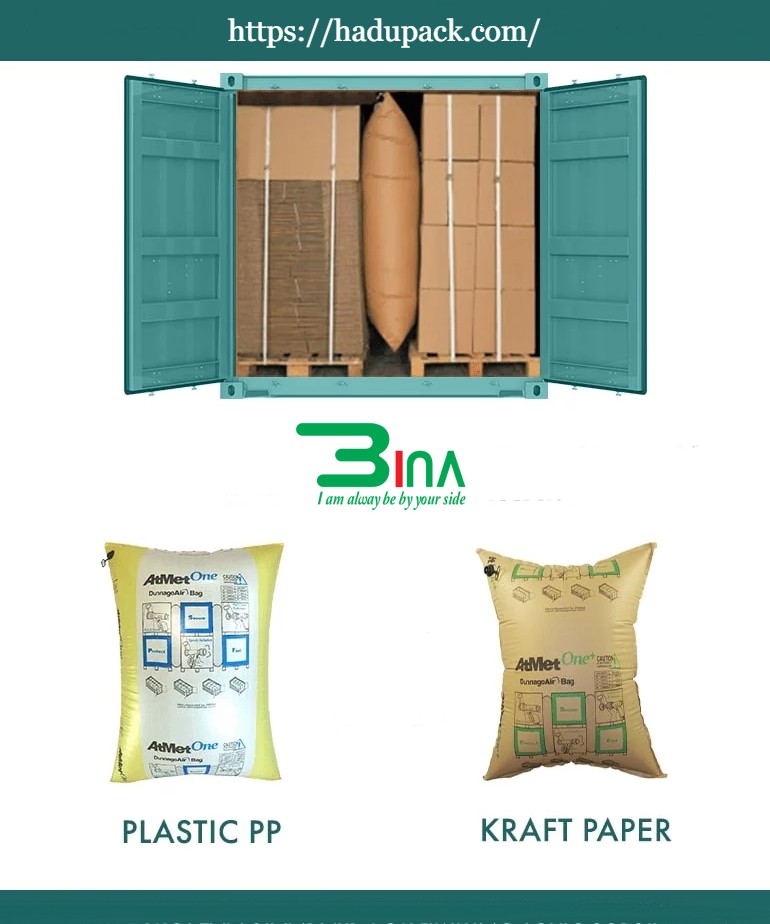
Container dunnage air bags are primarily used to fill gaps between goods, preventing movement and damage during transportation. They are mainly classified into two types based on material and durability: kraft paper air bags (suitable for securing general cargo, with good tear resistance) and woven PP air bags (suitable for heavy or moisture-sensitive cargo, with extremely high tear resistance and load-bearing capacity). Below is a detailed classification based on material and application:
1. Classification by material
Kraft paper air bags:
Features: The outer layer is made of high-quality kraft paper, while the inner layer is plastic film, providing high strength and sturdiness.
Applications: Suitable for road, sea, and air transportation, commonly used to secure fragile items, machinery parts, etc.
| Specification information | Kraft PP air bag |
| Composition components | Outer layer:
Inner layer:
|
| Width | 50 – 150cm ± 0.5cm |
| Length | At the customer’s request |
| Working pressure | 2.8 psi |
| Explosion pressure | ≥ 6 psi |
| Operating environmental conditions | -30ºC to 70ºC |
| Number of reuses | 3 – 4 times |
| Storage conditions | Temperature < 38ºC, humidity 45 – 75% |
PP woven bags:
- Features: The outer layer is made of high-strength woven polypropylene fabric, with excellent tear resistance and extremely high load-bearing capacity, offering superior waterproof and moisture resistance compared with kraft paper.
- Applications: Suitable for heavy machinery, steel coils, large stone products, wood products, and other heavy goods or goods with sharp edges.
| Specification information | PP air bag |
| Composition components | Outer layer:
Inner layer:
|
| Width | 50 – 150cm ±0.5cm |
| Length | At the customer’s request |
| Working pressure | 3 – 10 psi |
| Explosion pressure | 8 – 21 psi |
| Operating environmental conditions | -30ºC to 70ºC |
| Number of reuses | 4 – 5 times |
| Storage conditions | Temperature < 38ºC, humidity 45 – 75% |
2. Classification by structure/design characteristics
- Single-layer or multi-layer design: Depending on the weight to be supported and the size of the gap, air bags can be made from one or multiple layers of composite materials. The more layers, the stronger the pressure resistance.
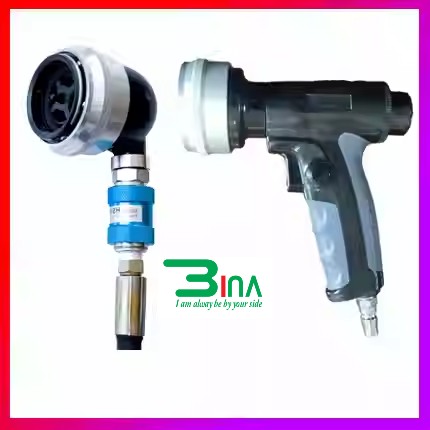
- Quick-inflation type: Equipped with a specialized valve, quick-inflation air bags are suitable for highly efficient packaging operations.
3. Basis for selecting air bags
- Cargo weight: Choose ordinary kraft paper air bags for lightweight cargo and PP woven air bags for heavy cargo.
- Gap size: Measure the distance between the goods to be packaged and choose an air bag of an appropriate size to avoid situations where it is too small to secure the goods or too large to fit in.
- Transportation environment: For long-distance sea transportation or goods that may be exposed to moisture, PP woven air bags should be prioritized.
How to choose container dunnage air bags
The choice of container dunnage air bags (inflatable air bags for containers) mainly depends on the type of cargo, the clearance between the cargo and the container, the transportation environment and the budget. When choosing, you need to measure the clearance, select the appropriate material (kraft paper, woven bag) and size, while ensuring good compression resistance and puncture resistance. It is recommended to purchase from manufacturers certified by AAR (Association of American Railroads). How to choose container dunnage air bags.
Measure the clearance between the cargo and the container
Measure the maximum width between the cargo and the container. The width of the air bag should be equal to or slightly greater than this distance. If the gap is too large, the effectiveness of the air bag will decrease; if the gap is too small, it will be difficult to fill.
- Normally, if the gap is small <30cm, an air bag is usually not needed or only a small-sized air bag is required.
- If the gap is large >40cm, a large-sized air bag is required.
Standard clearance:
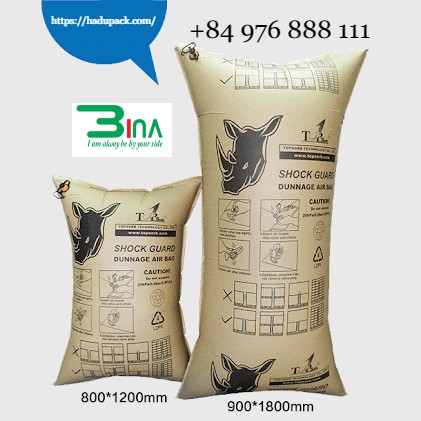
| Airbag dimensions (mm)(Width x Length) | Clearance height (mm) | Gap width (mm) | Usable height (mm) |
| 500 x 1000 | 200 | 300 | 900 |
| 800 x 1200 | 250 | 350 | 1100 |
| 900 x 1800 | 250 | 350 | 1700 |
| 1000 x 1800 | 300 | 400 | 1700 |
| 1000 x 2000 | 300 | 400 | 1900 |
| 1000 x 2200 | 300 | 400 | 2100 |
| 1200 x 2400 | 400 | 500 | 2000 |
 |
Airbag Material Selection
- PP woven bags (woven airbags): High strength, good water resistance, abrasion resistance, suitable for heavy goods, sharp-edged goods, humid environments, or long transportation times.
- Kraft paper airbags: Low cost, environmentally friendly, and high friction, suitable for ordinary dry goods, lightweight goods, road transportation, or short transportation times.
- Determine the airbag size: The airbag length should be slightly shorter than the actual stacking height of the goods to avoid excessive direct stress on the airbag or abrasion of the container floor.
- Selection based on transportation method and durability requirements: If multiple loading and unloading operations or long-distance sea transportation is required, heavy-duty airbags with stronger pressure resistance should be selected (such as AAR certification).
 |
- Prioritize AAR-certified suppliers: Products certified by the AAR (Association of American Railroads) represent higher quality standards and are suitable for international long-distance transportation.
- Refer to the manufacturer’s core specifications: Find out the product’s maximum working pressure, burst pressure, and material thickness.
- Determine purchasing specifications: Clarify the required dimensions of 1000mmx1800mm, 1000mmx2000mm type (woven fabric or paper) and quantity.
- Find qualified factories: Search for keywords such as “container air bags” or “container dunnage bags” on international trade platforms or via https://hadupack.com to learn about pricing and compare sample quality.
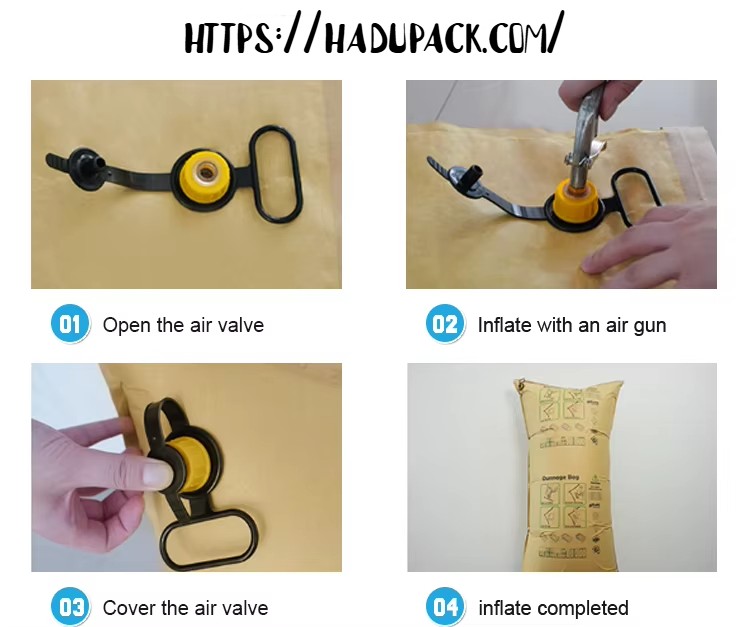
- Usage instructions: Inflate the air bag to 80%-90% to avoid overinflation, which may cause it to burst during transportation.
It is recommended to use cardboard wrapped around the air bag to prevent sharp edges from puncturing the bag.








Reviews
There are no reviews yet.