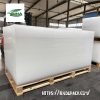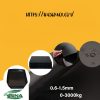



Description
What is PVC heat-shrink film
PVC heat-shrink film (polyvinyl chloride heat-shrink film) is a packaging material with high transparency, high gloss, high shrinkage, and relatively high rigidity. It is produced from PVC resin with plasticizers and other additives through a two-stage blowing process, allowing it to tightly wrap objects when heated. It is commonly used for sealing, moisture resistance, dust protection, and color label printing on food, pharmaceutical, chemical, and daily consumer products.
 |
 |
◆Learn more:
- https://hadupack.com/san-pham/mang-nhua-pet/
- https://hadupack.com/san-pham/mang-mpet/
- https://hadupack.com/san-pham/mang-cpp/
PVC heat-shrink film production process
The PVC heat-shrink film production process mainly uses the blown extrusion method. Through key steps such as raw material mixing, hot-melt extrusion, blowing and stretching, rapid cooling and shaping, the film molecules become oriented, resulting in a high shrinkage rate when heated. The core process is:
- Raw material preparation (PVC resin, plasticizer, stabilizer)
- High-speed mixing
- Pelletizing extrusion/film extrusion
- Second blowing (orientation)
- Cooling and shaping
- Packaging.
1. Formulation and raw material preparation
- The performance of PVC heat-shrink film is determined by the formulation. The core components include PVC resin, stabilizers, plasticizers, lubricants, antistatic agents, etc.
- Raw material composition: SG-4 or SG-5 suspension-grade PVC resin is commonly used.
- Mixing process: Use a high-speed mixer, with friction generating heat to 120 degrees C – 130 degrees C, then cool and mix to obtain a dry blend, and then let it stand at room temperature for 24-48 hours to ensure uniformity of the components.
 |
2. Flat-blown extrusion process
This is currently the main production method:
- Plasticizing extrusion: The mixed material is fed into the extruder and melted and plasticized at a temperature of 170~195℃. The die head uses a cross-type or vertical flat-blown die head.
- Initial orientation and air blowing: The melt is extruded through the die head to form a bubble tube. It is cooled by an air ring, and air is introduced to inflate the bubble tube for the first time.
- Water bath setup and second air blowing: This step is crucial for achieving a high shrinkage ratio. The bubble tube is passed through a hot water bath (approximately 1000 mm) to heat and soften it, then undergoes secondary horizontal inflation and significant longitudinal stretching through traction, causing the PVC molecular chains to reorient.
- Cooling after shaping: The inflated film bubble is immediately and rapidly cooled through a cold-water jacket (approximately 1000 mm) to fix the oriented molecular structure.
 |
3. Key points of the production process
- Temperature control: The temperature of the molten plastic needs to be controlled within a certain range. Excessively high temperatures will lead to decomposition, while excessively low temperatures will result in poor plasticization.
- Stretching speed and ratio: The blow-up ratio (the ratio of tube diameter to die diameter) and stretching speed directly affect the final shrinkage ratio and thickness uniformity.
- Cooling and forming: Rapid cooling is very important. The temperature of the forming water and the cooling method affect the transparency and shrinkage stability of the film.
4. Post-printing processing and finished products
- Orientation treatment: The film requires special process adjustments to control the transverse shrinkage ratio to be higher than the longitudinal shrinkage ratio or to meet requirements.
- Winding and finishing: The film undergoes surface treatment (such as corona treatment) to improve printability, and is finally rewound.
 |
Key features:
- High aesthetics: High transparency and gloss enhance product quality.
- High conformity: High shrinkage rate, suitable for many products with irregular shapes, providing perfect wrapping.
- High durability: Puncture-resistant, dustproof, and moisture-resistant, ensuring safe transportation and storage.
- Low cost: High cost-performance ratio, making it a classic traditional packaging material.
- Good printability: Can be processed into colored heat-shrink labels, commonly used for labeling bottles and cans.
- Application scenarios: Widely used for individual or combined packaging of hardware products, toys, beverages, cosmetics, electronic devices, and other products.
Note: PVC has poor environmental performance and produces toxic gases when burned. Its use is restricted in some regions (such as Europe and Japan) and is gradually being replaced by environmentally friendly POF shrink film.
 |
Applications of PVC Shrink Film
PVC shrink film is a widely used thermoplastic heat-shrink packaging material. Thanks to its high transparency, high shrinkage rate, dust resistance, moisture resistance, and ease of processing, it is widely used for individual or combined packaging of food products, pharmaceuticals, daily consumer chemicals, beverage bottles, electronic equipment, and building materials. Common forms include tubular film, L-shaped folded film, and shrink labels. Main applications of PVC shrink film:
- Bottle and container labels (shrink film): Widely used as bottle labels on containers for mineral water, wine, cosmetics, healthcare products, etc., creating a 360-degree display effect and suitable for various bottles with complex shapes.
- Tamper-evident and sealing packaging: Used for heat-shrink sealing around bottle mouths and caps to ensure the integrity and airtightness of the packaging, preventing leakage or counterfeiting during transportation.
- Light industrial and electronic product packaging: Suitable for packaging toys, stationery, handicrafts, daily necessities, pharmaceuticals, and electronic components, providing sealed, aesthetic, and transparent protection.
- Bundled packaging: Groups multiple identical or irregularly shaped items together for easy transportation and sales; commonly used for food gift boxes and promotional product sets.
- Protection of building materials and hardware: Used to protect the surfaces of building materials such as doors, windows, and pipes, as well as hardware tools.
 |
Classification of PVC heat-shrink film
PVC heat-shrink film is classified into printing type (used for bottle labels, with high transparency and high shrinkage) and general packaging type (used for product packaging, such as tubes and profile bars) based on application, thickness, and performance. It is characterized by high transparency, high rigidity, and low shrinkage temperature, and is widely used in food, pharmaceutical, and electronic packaging. Specific classifications of PVC heat-shrink film:
 |
By application:
- Printed shrink film: Specially designed for printing various types of packaging labels, with high transparency, gloss, and shrinkage adaptability, meeting the requirements of high-speed automatic labeling machines.
- General packaging shrink film: Used for packaging ordinary items, such as tubular film, L-fold film, and single-sheet film. It can be used to make tubular bags, flat bags, etc., with generally lower printing quality.
By thickness/process:
Tube/bottle label film: Usually 35-75 microns thick, produced through calendering and transverse stretching processes, with excellent shrinkage and flatness.
Classification by material structure:
- Rigid PVC shrink film: High shrinkage rate and high rigidity, suitable for label films.
- Soft PVC shrink film: Contains plasticizers, providing good flexibility, elasticity, and impact resistance.
Classification by application scenario:
- Medical grade: Special packaging that meets hygiene requirements.
- Industrial grade: Used for packaging heavier items such as electronic equipment, hardware accessories, and building materials.
 |
Disadvantages of PVC shrink film
The main disadvantages of PVC shrink film are poor environmental performance, a tendency to release toxic gases (such as hydrogen chloride) at high temperatures, brittleness at low temperatures, poor thermal stability, and unsuitability for food packaging. Its raw materials contain chlorine, and its waste generates environmental pollutants such as dioxins. Furthermore, the heat-shrinking process is difficult to control, resulting in inconsistent quality. Detailed analysis of the disadvantages of PVC shrink film:
 |
Environmental and safety issues (serious drawbacks):
- Release of toxic gases: When using a heat gun for sealing, PVC can release hydrogen chloride gas, which has a pungent odor and is toxic.
- Not environmentally friendly: PVC is a type of plastic that is not environmentally friendly; when burned, it produces toxic substances such as dioxins, causing serious environmental pollution.
- Hazards from plasticizers: To increase flexibility, plasticizers (phthalates) may be used in production. When used in food packaging, these substances can migrate, posing safety risks.
Limitations in physical performance:
- Poor thermal stability: Low heat resistance; easily decomposes when exposed to high temperatures for prolonged periods.
- Brittle at low temperatures: At low temperatures, PVC film easily becomes brittle and cracks, reducing its protective effectiveness.
- Poor weather resistance: Prolonged exposure to sunlight can easily lead to aging and discoloration.
Processing and packaging issues:
- Unstable shrinkage rate: It is difficult to control a consistent shrinkage rate during production, easily resulting in inconsistent packaging quality.
- Brittleness: Compared with POF material, PVC is harder after sealing and is more prone to cracking during transportation.
 |
Common Problems and Solutions with PVC Shrink Film
PVC shrink film is known for its low cost, high shrinkage rate, and good transparency. However, due to its environmental limitations (hydrogen chloride emissions), poor heat resistance (easily damaged at 40-60℃), and tendency to become brittle and yellow after long-term storage, it is often used to package low-cost daily consumer goods. Common problems (bulging, cracking) are usually addressed by increasing ventilation holes, lowering the temperature, or replacing it with more environmentally friendly and durable POF shrink film. Common problems and preventive measures for PVC shrink film:
Common Problems and Solutions:
- Bulging inside the package: This is caused by hot air remaining inside the package. Solutions include increasing ventilation holes or appropriately reducing the packaging machine speed to allow the hot air time to escape.
- Film cracking or uneven shrinkage: This is usually caused by excessive temperature or a conveyor speed that is too slow. PVC shrink film is extremely sensitive to temperature and usually shrinks completely at around 100℃. If the packaging machine temperature is too high, it can easily lead to local overheating and cracking.
- Low transparency, brittleness, and yellowing: When PVC is stored for a long time, the added plasticizers evaporate, causing the packaging to yellow and become brittle. Physical and environmental limitations:
- Not suitable for food packaging: Additives may leach out, and combustion produces toxic gases (hydrogen chloride), making it unsuitable for direct food contact.
- Poor weather resistance: Long-term exposure to sunlight can cause photo-oxidative aging, resulting in discoloration and brittleness.
- Storage conditions: PVC should be stored at room temperature below 25℃. Temperatures above 40℃ can reduce packaging quality.
 |
Advantages and disadvantages compared with POF:
Compared with PVC (polyvinyl chloride) film, POF (polyolefin multilayer co-extruded) shrink film has core advantages such as being environmentally friendly, non-toxic, highly transparent, highly durable, and having a lower overall cost, making it the preferred choice for modern high-speed packaging. The advantages of PVC include low cost, low sealing technology requirements, and a high shrinkage rate, but due to its environmental limitations, brittleness, and rigid seals, it is gradually being replaced by POF.
 |
 |
Comparison of the advantages and disadvantages of PVC film and POF film:
1. POF film (Polyolefin shrink film)
POF is a type of heat-shrink film, mainly composed of linear low-density polyethylene (LLDPE) and copolymer polypropylene (PP).
Advantages of POF shrink film:
- Environmentally friendly and hygienic: Non-toxic and odorless, meets FDA and USDA standards, and does not produce harmful gases during the packaging process.
- High strength and flexibility: High tear resistance, soft texture, and flexible corners at the seal, preventing cuts.
- Transparency and shrinkage: High transparency, good gloss, adjustable shrinkage (up to 75% or more), tight seals.
- Excellent cold resistance: Does not become brittle or break easily under cold conditions, making it suitable for frozen food packaging.
- Suitable for high-speed packaging: Suitable for high-speed automatic packaging machines.
Disadvantages of POF shrink film:
- High requirements for heat-sealing equipment: Requires circulating air; ventilation holes are needed at the seal to prevent the expansion of air inside.
- Initial raw material cost: At the same thickness, the raw material cost of POF is usually slightly higher than PVC (but the actual total cost is lower because thinner film can be used).
 |
2. PVC Shrink Film (Polyvinyl Chloride Heat-Shrink Film)
PVC is a heat-shrink material that was used earlier and is more widely used.
Advantages of PVC shrink film:
- Low cost: Inexpensive; the material itself has a significant price advantage.
- Simple processing technology: High shrinkage rate; the shrinking process can be completed at low temperatures, requiring less stringent hot-air speed requirements for the equipment.
- High rigidity: Quite rigid after packaging.
Disadvantages of PVC shrink film:
- Not environmentally friendly: May release toxic substances during production and use; easily produces unpleasant odors during processing.
- Very brittle: Easily becomes brittle and breaks at low temperatures.
- Packaging effect: Sharp heat-shrink seals can easily cut hands.
- Heavy weight: High density (approximately 1.4), even thinner sheets are relatively heavy.