


Description
What is tamper-evident label printing?
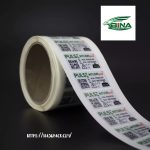
Tamper-evident label printing is the process of printing anti-tampering labels using vinyl to create highly secure, self-destructing stickers designed to tear, break, rip, or display the characters “VOID” when someone attempts to remove them. Made from fragile or “eggshell-like” vinyl and permanent adhesive, these labels provide immediate visual evidence of unauthorized access, protecting against fraud, counterfeiting, and warranty violations.
 |
◆Learn more:
- https://hadupack.com/san-pham/decal-giay-kraft-nau/
- https://hadupack.com/san-pham/in-tem-bao-hanh/
- https://hadupack.com/san-pham/in-tem-niem-phong/
Key aspects of anti-tampering labels using destructible vinyl label printing:
- Destructible material: The vinyl layer, typically 2 mil or 5 mil thick, breaks into small, irreparable pieces if someone attempts to peel it off.
- Irreversible evidence: Once applied, the strong adhesive prevents reapplication, making tampering immediately noticeable.
- Durability: These labels withstand harsh conditions, including chemicals, high temperatures, humidity, and UV rays, making them suitable for industrial use.
- Customization: They can be printed with barcodes, QR codes, logos, and serial numbers, often using thermal transfer or flexographic printing methods.
 |
Common applications in everyday life:
- Electronics: Ensuring product warranty (e.g., covering screw holes or seams).
- Asset tracking: Protecting equipment to prevent tampering or theft.
- Pharmaceuticals/Cosmetics: Sealing medicine or cream boxes to ensure product integrity.
- Automotive: Using metallic vinyl for serial number labels or tamper-evident labels.
 |
These labels, commonly referred to as “eggshell” labels, cannot be peeled off intact, ensuring that if the seal is broken, it will be detected immediately.
 |
 |
Production process for tamper-evident labels
The printing and production process for anti-counterfeiting labels (such as VOID labels, destructible paper labels, and holographic anti-counterfeiting labels) is a complex process that combines high-precision printing with specialized anti-counterfeiting technologies to achieve a “tear-off” or “text display” function. The core processes include: design finalization, material selection and die-making, special printing (including anti-counterfeiting inks/holographic images), lamination and composite processing, die-cutting and waste removal, quality inspection, and traceability.Tamper-evident label production process
The printing and production process for anti-counterfeiting labels (such as VOID labels, destructible paper labels and holographic anti-counterfeiting labels) is a complex process that combines high-precision printing with specialized anti-counterfeiting technologies to achieve a “tear-off” or “text display” function. The core processes include: design finalization, material selection and die-making, special printing (including anti-counterfeiting inks/holographic images), lamination and composite processing, die-cutting and waste removal, quality inspection and traceability.
 |
I. Core Processes in the Production of Tamper-Evident Labels
- Security Design & Planning: Design patterns according to customer requirements, integrating VOID text, tearable structures or holographic images into the design.
- Plan special security features, such as barcodes, QR codes and serial numbers, for traceability.
- Material Selection: Substrate: Use special PET, specialized VOID materials, tearable paper or aluminum foil, etc.
- Adhesive: Use permanent adhesive to ensure that no traces or material residue remain when peeled off.
- Pre-Printing Preparation: Create anti-counterfeiting printing plates to ensure accurate text reproduction.
- Special Printing and Security Features
- Printing: UV flexographic printing, screen printing or offset printing.
- Special Anti-Counterfeiting Processes: Printing special hidden VOID graphics, three-dimensional embossing (laser anti-counterfeiting), invisible ink or thermochromic ink.
- Lamination and Coating: Laminate the backing paper and face material, and apply a release coating to a specific layer to ensure that the image appears when peeled off.
- Die-Cutting and Slitting: Die-cut the printed roll material into specific shapes (e.g., rounded squares, irregular shapes) and remove excess material.
- Digital Printing and Traceability: Print unique serial numbers and QR codes (NFC/RFID) on each label to track products.
- Quality Control and Packaging: Conduct tear tests, text visibility tests and residue inspections.
- Automated inspection equipment removes defective labels and finally, the labels are packaged into strips.
 |
II. Core Technical Features
- Irreversible: Once the label is peeled off, it cannot be restored, leaving clear evidence (such as the word “VOID” or damage to the holographic pattern).
- High security: Uses holographic elements and high-security inks to enhance anti-counterfeiting capabilities.
- Traceability: Serial-numbered barcodes and QR codes are linked to a database.
 |
III. Common Applications
- Sealing labels: Seals for electronic products and pharmaceutical logistics.
- Warranty labels: Easily torn paper; tearing it will void the warranty.
- Anti-counterfeiting labels: Anti-counterfeiting for high-end branded products.
 |
Classification of tamper-evident label printing
Tamper-evident labels are classified according to their reaction when removed, mainly including destructible labels (breaking into pieces), VOID labels (revealing hidden text) and residue-leaving types. These labels prevent, detect and protect products against unauthorized access, theft or counterfeiting in industries such as pharmaceuticals, electronics and food packaging.
 |
Main classifications of anti-tampering labels:
- Destructible/Fragile Labels: Made from vinyl or brittle paper, they break into small pieces that cannot be reapplied when removed.
- VOID Labels (Polyester): Leave the word “VOID” or a clear pattern on the surface, making reapplication impossible.
- Residue-Leaving/Full Transfer: Leave residue.
- Residue-Free/No Transfer: Leave no residue, suitable for sensitive, clean surfaces.
- Perforated Sealing Labels/Films: Commonly used on bottles or containers, they tear along the perforations when opened.
- Holographic Labels: Incorporate unique security holograms that are nearly impossible to replicate, providing visual authenticity along with tamper evidence.
- Security Slits: Labels with pre-cut slits tear when removal is attempted, making them an effective, low-cost option.Main classifications of anti-tampering labels:
- Destructible/Fragile Labels: Made from vinyl or brittle paper, they break into small pieces that cannot be reapplied when removed.
- VOID Labels (Polyester): Leave the word “VOID” or a clear pattern on the surface, making reapplication impossible.
- Residue-Leaving/Full Transfer: Leave residue.
- Residue-Free/No Transfer: Leave no residue, suitable for sensitive, clean surfaces.
- Perforated Sealing Labels/Films: Commonly used on bottles or containers, they tear along the perforations when opened.
- Three-dimensional labels (Holographic Labels): Incorporate unique security holograms that are nearly impossible to replicate, providing visual authenticity along with tamper evidence.
- Security slits (Security Slits): Labels with pre-cut slits tear when removal is attempted, making them an effective, low-cost option.
 |
Tips for Preserving Tamper-Evident Labels
To preserve tamper-evident labels, apply them to a clean, dry surface at room temperature, allow them to dry for 24 hours, and avoid excessive heat or humidity. Proper storage, such as keeping labels away from direct sunlight, high temperatures, and humidity, helps ensure their long-term effectiveness. Ensure the surface is clean, dry, and free of oil, dust, or moisture to prevent premature damage.
 |
- Optimal drying time: Allow the label to dry for at least 24 hours before inspection or transportation. Although some adhesives work within minutes, a longer drying time will significantly improve performance.
- Surface selection: Smooth, non-porous surfaces (glass, polished metal) provide the best adhesion. For porous or rough surfaces (paper, cardboard), consider using labels with stronger adhesives.
- Storage conditions: Store unused labels in a cool, dry, well-ventilated place, ideally at a temperature ranging from to ( 4 degrees C to 38 degrees C) with a humidity level of 20-60%. Avoid direct sunlight and rain.
- Application technique: Press firmly over the entire label to ensure complete and even adhesion. When applying to corners or seams, ensure the label wraps far enough to adhere securely to both surfaces, preventing peeling.
- Environmental protection: For products exposed to moisture, abrasion, or harsh environments, choose labels with a special coating (glossy or matte) to protect the label material and printed image.
Usage note: For sensitive devices or product seals, use UV-resistant or moisture-resistant materials if the product is stored outdoors.