

Description
What is plastic label printing?
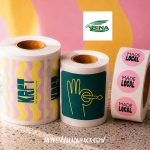
Plastic label printing is a process of transferring images and text onto plastic film materials such as PVC, PET, and BOPP through methods such as relief printing, gravure printing, or flexographic printing, creating labels with properties such as water resistance, abrasion resistance, and high adhesion. This technology is mainly used for packaging mineral water bottles, daily chemical products, food and beverages, including types such as self-adhesive labels, heat-shrinkable films, and in-mold labels.
 |
I. Key features of plastic label printing
- Waterproof and moisture-resistant: Plastic materials have a smooth surface, are heat-resistant, moisture-resistant, and do not age, making them suitable for humid or cold environments.
- High adhesion: Strong adhesion, firmly adhering to various curved bottle surfaces.
- Clear and attractive: Rich and vibrant colors, fade-resistant, highlighting the product image.
- Highly customizable: The size, shape, and type of adhesive (such as transparent, matte, and colored) can be customized according to requirements.
II. Common materials
- PVC/PP/PE/PET: Common film labels, highly transparent, with good-quality materials.
- Synthetic paper (Pearlescent Film/Pearlescent Paper): Combines the waterproof properties of plastic with the printability of paper.
- Heat-shrink film: Shrinks when heated, particularly suitable for irregularly shaped bottles (such as shrink film labels).
III. Core Printing Processes
- Letterpress printing: Commonly used for plastic self-adhesive labels, with saturated colors.
- Gravure printing: Used for heat-shrink film, with thick color layers and high print durability.
- Flexographic printing: Suitable for high-quality plastic film labels in large quantities.
- Screen printing: Thick ink layers, with a strong three-dimensional effect.
In-Mold Labeling (IML): The printed label is placed directly into the mold, forming a single, attractive, and durable label with the plastic container.
 |
Structure of plastic labels
Plastic labels usually consist of three parts: the surface layer, adhesive layer and liner. They are made from synthetic plastic materials such as PET, PP and PVC, and have properties such as water resistance, oil resistance, tear resistance and environmentally friendly recyclability. This structural design creates a strong bond between the printed content and the packaging, and is commonly used for packaging daily necessities, food and electronic products.
 |
◆Learn more:
- https://hadupack.com/san-pham/mac-det/
- https://hadupack.com/san-pham/in-tem-ma-vach/
- https://hadupack.com/san-pham/in-tem-nhan-cuon/
Key components of plastic label construction:
- Face stock: The top layer of the label, carrying the printed information. Common materials include polyester (PET), polypropylene (PP), polyethylene (PE), and polyvinyl chloride (PVC), with varying levels of transparency, heat resistance, and chemical resistance.
- Adhesive: Bonds the face stock firmly to the packaging; there are permanent and removable adhesive types.
- Liner: Protects the adhesive layer and separates the label from the protective layer; it is peeled off during use.
 |
Classification of plastic label printing
Plastic label printing is mainly classified according to material properties, application methods, and printing processes. Common materials include PET, PP, PVC, PE, and synthetic paper, which offer resistance to water and oil; common forms include in-mold labels, self-adhesive labels, and heat-shrink films; printing processes mainly include relief printing, flexographic printing, gravure printing, and screen printing, suitable for cosmetic, food, and daily consumer chemical product packaging.
 |
I. Classification by label material
- PET (Polyethylene Terephthalate): High transparency, high rigidity, good chemical resistance, suitable for high-end labels, such as bottle labels.
- PP (Polypropylene): Environmentally friendly and recyclable, heat-resistant, commonly used for containers for daily-use chemicals and food, including transparent PP, white PP, and pearl film.
- PVC (Polyvinyl Chloride): Good flexibility, corrosion resistance, excellent water resistance, suitable for outdoor packaging or general chemicals.
- PE (Polyethylene): Soft and lightweight, mainly used for flexible packaging.
- Synthetic paper: Combines the properties of plastic and paper, with a special surface coating, providing water and tear resistance.
II. Classification by application method
- Self-adhesive labels: Printed directly onto the surface, with adhesive on the back; highly versatile and widely used.
- In-mold labels (IML): Pre-printed plastic labels are placed into an injection mold, forming the label and container in one step; aesthetically pleasing and durable.
- Shrink labels: Printed on cylindrical film, which can be heat-shrunk onto bottles; suitable for irregularly shaped bottles.
III. Classification by printing process
- Flexographic/relief printing: Currently the dominant label printing method; fast, suitable for mass production and producing vibrant colors.
Screen printing: Suitable for special effects; produces a thick ink layer. - Gravure printing: Extremely high print quality; suitable for sophisticated products and large-volume production.
- Digital printing: Suitable for small batches, diverse applications, and variable data.
IV. Classification by characteristics
- Transparent labels: Clearly display the contents inside the container, providing an eye-catching appearance.
- Metallic/matte silver labels: High quality, corrosion-resistant, commonly used for household appliances or premium products.
- Cold-resistant/super-adhesive labels: Used for packaging in harsh environments, resistant to peeling.
 |
Plastic label production process
The production process for printing plastic labels mainly includes prepress design, corona treatment (to increase adhesion), printing (gravure/flexographic/digital printing), drying and curing, post-print processing (die-cutting/hot stamping), slitting and roll forming, quality inspection, and packaging. UV inks are commonly used to ensure color protection and high adhesion. The entire process emphasizes precise alignment and post-print surface treatment to meet the requirements for decoration and high gas-barrier performance of packaging.
 |
Detailed production process
- Pre-print preparation: Design, color separation and plate making (e.g.: gravure or flexographic printing plates) according to customer requirements.
- Substrate treatment (Corona Treatment): Corona treatment is applied to PET, PE, BOPP and other plastic films to increase surface tension and help the ink adhere more easily.
Printing:
- Gravure/Flexographic Printing: Suitable for mass production, with vibrant colors, commonly used in high-end flexible plastic packaging.
- Digital Printing: Suitable for small batches and personalized customization, with fast turnaround.
- Drying and curing: UV lamps or drying ovens are used to immediately dry the printed plastic film to prevent blocking.
Post-printing processing:
- Lamination: Laminate the printed film with another layer of plastic film or foil to enhance functionality.
- Surface treatment: Hot stamping, lamination (matte/glossy) to improve texture.
- Die cutting: Cut film rolls into specific label shapes.
- Slitting and finished product inspection: Slit the film into narrow strips suitable for automatic labeling machines, and inspect dimensions, colors and printing defects using quality control equipment.
- Packaging and storage: Package and cure at room temperature to ensure the ink is fully stabilized.
This process is widely used in plastic bottle labeling, shrink sleeve labeling and other fields, characterized by short production cycles, high-quality labels, and water and abrasion resistance.
 |
Applications of Plastic Label Printing
Plastic label printing is widely used for beverage bottles, food packaging, daily consumer chemical products, pharmaceuticals, and industrial products. Thanks to its high transparency, water resistance, abrasion resistance, and corrosion resistance, it commonly uses materials such as PE, PP, PVC, and PET, applying techniques such as UV printing and flexographic printing to achieve high quality, surface durability, and good information communication.
Main application areas of plastic label printing:
- Daily consumer chemical packaging: Shampoo bottles, laundry detergent, and cosmetics, requiring extremely high water resistance and chemical corrosion resistance.
- Food and beverage labels: Labels for mineral water, juice, and carbonated beverage bottles (especially shrink sleeve labels and neck labels), mainly utilizing the properties of PET/PP materials.
- Industrial and household appliance labels: Nameplates or markings for electronic products, automotive parts, oil drums, and chemical containers, requiring long-term abrasion resistance and chemical stability.
- Commercial and retail applications: Customized items such as business cards, gift cards, luggage tags, and clothing hang tags.
- Warehouse and logistics management: Industrial-grade self-adhesive labels requiring long-term adhesion and the ability to withstand harsh environments.
 |
Storage of plastic labels
Plastic labels (especially self-adhesive labels) should be stored in a dry, cool, and enclosed place. The storage environment should be maintained at a temperature of 22 degrees C and a relative humidity of 50 – 65%. The labels should be tightly wrapped in plastic film to avoid direct sunlight and moisture, preventing deterioration, leakage, or adhesive sticking.
 |
Here are the specific storage points:
- Sealing and packaging: Plastic labels (especially front-facing types) should be kept in their original plastic film packaging. After use, the remaining labels should be resealed to prevent moisture and surface aging.
- Temperature and humidity control: The optimal storage environment is a temperature of 20°C – 25°C and relative humidity of 40% đến 60% RH. Excessive humidity may cause the labels to wrinkle and may also lead to adhesive failure; heat-sensitive materials will fade more quickly when exposed to moisture.
- Environmental requirements: Avoid direct sunlight, heat sources, and direct contact with water.
- Storage method: Large rolls of labels should be stored vertically to avoid localized pressure that could cause adhesive leakage; If stacking multiple layers, they should not be too heavy to prevent adhesive from leaking from the lower layers. Storage period: Under standard temperature and humidity conditions, self-adhesive labels can generally be stored for 3-5 years.
By using the methods described above, the shelf life of plastic labels can be effectively extended, ensuring good adhesion and clear printing during use.