



Description
What are clay desiccant beads?
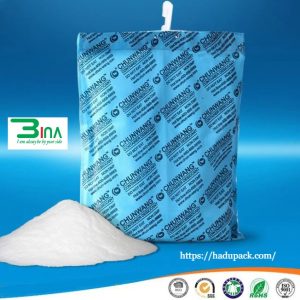
Clay desiccant beads are clay-based drying agents made from montmorillonite, a type of clay with a particular affinity for moisture. Clay desiccants are non-hazardous adsorbents found in nature. They consist of an attractive layered structure of calcium and aluminum silicates that are chemically stable and non-corrosive. Moisture is absorbed and retained between the layers.
 |
Clay desiccant is a low-cost and highly effective desiccant that can absorb 40% of its own weight in water vapor within a suitable temperature and humidity range. It is widely used in industries that require humidity control. Even after being crushed, processed, and packaged, clay desiccant can still be regenerated at lower temperatures without being destroyed or expanding.
 |
☞See more:
Clay Desiccant Granule Production Process
Clay desiccants are primarily made from natural clay minerals such as attapulgite and bentonite, through processes including purification, granulation, drying, and calcination. They are environmentally friendly, non-corrosive physical adsorption desiccants. The core processes are: raw material purification (removing impurities) -> mixing and granulation (adding a binder) -> drying and screening (shaping) -> high-temperature activation (accelerating moisture absorption, usually during calcination).
I. Detailed production process for clay desiccants
- Raw material selection and preparation: High-purity attapulgite or bentonite is commonly selected because these minerals have a unique microporous structure and strong water absorption capacity.
- Activation/modification treatment (Important step): The clay is modified by acid washing or the addition of chemical agents to remove impurities, improve the pore structure and enhance moisture absorption capacity.
- Granulation and shaping: Finely ground clay is mixed with an appropriate amount of water and binder (usually natural materials), then ground in a mixer to produce small spherical granules.
Drying and firing (kiln drying): The wet, finely ground material is dried in drying equipment. The key point is to activate the material during the drying process, removing free water and water of crystallization from the particles through heat treatment at around 150 degrees – 300 degrees C, creating numerous adsorption pores. - Finished product packaging: After cooling, the clay granules are screened to select those that meet the standards, then packaged using environmentally friendly materials (such as nonwoven fabric and composite paper).
II. Ingredients and characteristics
- Ingredients: Attapulgite clay, bentonite.
- Characteristics: Mineral desiccant, neutral, does not flow back after absorbing water, safe and environmentally friendly, maintains good moisture absorption performance at low humidity.
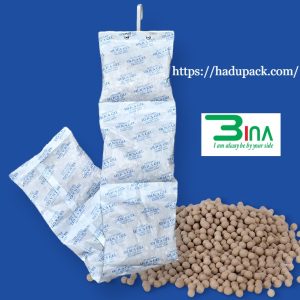
- Appearance: Mainly small spherical particles, grayish yellow or grayish white in color.
This desiccant is widely used in moisture-proof packaging in the electronics, textile, and measuring instrument industries thanks to its high moisture absorption capacity, environmental friendliness, and low cost.
Function of clay desiccant beads
Clay desiccants are primarily used to absorb moisture from the air, thereby reducing air humidity. In humid environments, objects are easily affected by moisture, leading to problems such as decay and mold. Using clay desiccants can effectively prevent these problems from occurring and protect items.
The suitable temperature range for clay desiccant is ≤50℃. If the temperature is higher than this level, moisture may escape because the rate of moisture evaporation is greater than the rate of moisture vapor absorption. Generally, users can decide whether to use clay desiccant based on the expected storage time or transportation conditions. In short, clay desiccant is an inexpensive and effective desiccant, in the form of small, gray, irregularly shaped granules.
 |
Using clay desiccant beads
- Choose a suitable clay desiccant. There are many different brands of clay desiccants on the market, and you can choose products with different specifications and materials according to your needs.
- Place the clay desiccant. Place clay desiccant beads in areas that need moisture protection, such as wardrobes, shoe cabinets, study rooms, etc.. In general, 1-2 clay desiccant beads should be placed per square meter.
- Regular replacement. The clay desiccant will become saturated after a period of use and needs to be replaced. Generally, you can replace it once a month.
- Note: When using the clay desiccant, be careful not to let it come into contact with water. At the same time, if the clay desiccant shows obvious deformation or discoloration, it needs to be replaced promptly.
In summary, clay desiccant is a very practical, easy-to-use moisture absorber with significant effectiveness. In humid environments, using clay desiccant can effectively protect items and extend their lifespan. I hope everyone can use clay desiccant correctly to achieve outstanding results.