



Description
What is POF shrink film?
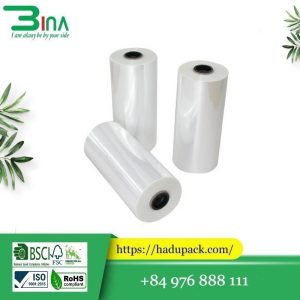
POF shrink film (full name: multilayer extruded polyolefin shrink film, polyolefin shrink film) is an environmentally friendly plastic packaging material with high transparency that shrinks to tightly wrap items when heated.
 |
◆Learn more:
- https://hadupack.com/san-pham/tui-opp/
- https://hadupack.com/san-pham/cot-khi-chong-soc/
- https://hadupack.com/san-pham/mang-co-nhiet-pvc/
Known for its thinness, durability, tear resistance, cold resistance (does not become brittle at -50℃), and excellent sealing properties, it is an environmentally friendly alternative to traditional PVC film and is widely used in food, daily consumer goods, and pharmaceuticals.
 |
POF Shrink Bag Production Process
POF shrink bags (multilayer co-extruded polyolefin) are manufactured using a three-layer co-extrusion process consisting of LLDPE (middle layer) and PP copolymer (inner and outer layers), employing the double-bubble film method, high stretching, and blow molding. This process creates highly oriented molecular chains, resulting in high transparency, high shrinkage, and environmental friendliness. The general process is as follows: raw material mixing → extrusion → molding → double-bubble blow molding and stretching → cooling and shaping → cutting/edge folding → sealing and bag cutting.
 |
1. Raw materials and extrusion
- Main raw materials: Linear low-density polyethylene (LLDPE) is used as the intermediate layer to increase toughness, while polypropylene (PP) copolymer is used for the inner and outer layers to provide gloss and heat-sealing properties.
- Production equipment: Typically, five or three extruders are used simultaneously for co-extrusion, combining different molten raw materials through a co-extrusion die.
2. Forming process: Double-bubble method
This is a key process in POF production, determining the shrinkage performance of the product.
- Primary extrusion: After the raw materials are melted, they are extruded through an annular die to form a thick film tube.
- Cooling and preheating: After initial water cooling, the film tube is reheated in an oven to a high-elasticity temperature (above the glass transition temperature and below the melting temperature).
- Inflation and stretching: High-pressure air is injected into the film tube while longitudinal and transverse stretching (biaxial stretching) is performed, orienting the molecular chains under tension.
- Cooling and setting: The film tube is rapidly cooled with air while in the stretched state, thereby fixing the stretched state of the molecular chains and creating shrink memory.
3. Post-processing and bag making
- Slitting and folding: The film tube produced can remain as a flat tube, or it can be slit on one side or formed into a center-folded film as required.
- Bag making and sealing: The cooled and set POF film is cut to a fixed length and bottom-sealed or side-sealed using a bag-making machine to produce POF packaging bags.
4. Key characteristics of POF shrink film bags:
- Environmentally friendly and non-toxic: Environmentally friendly and hygienic, non-toxic, producing only carbon dioxide and water when burned, meeting environmental protection requirements.
- High transparency and gloss: Extremely high transparency, clearly displaying the product contents and enhancing visual appeal.
- High shrinkage rate and strength: The shrinkage rate is typically above 60%, with strong tear and abrasion resistance.
- Suitable for high-speed operations: Shrinks uniformly when heated, making it suitable for high-speed automatic packaging machines.
- Flexible sealing: Unlike PVC, POF has soft edges after shrinking and will not scratch hands.
 |
Classification of POF Shrink Bags
POF shrink bags (environmentally friendly polypropylene copolymer) are mainly classified by performance (standard, premium, cross linked), roll configuration (single layer, folded) and customization requirements (flat bags, curved bags). In terms of performance, premium film is suitable for low temperatures, while cross linked film is suitable for special packaging requiring high strength. By type, single layer film is suitable for high speed production lines, while folded film is suitable for small sealing machines. Main classifications of POF shrink bags:
1. Classification by Material Performance and Application
- Standard POF Film: Used for packaging general products such as daily necessities, hardware, stationery and food.
- Premium/Low Temperature POF Film: Features a high shrink ratio at low temperatures and low shrink force, making it particularly suitable for products requiring gentle packaging, such as chocolate, CDs and delicate paper boxes.
- Cross Linked POF Film: Offers higher transparency and shrink force, good toughness and strong puncture resistance, making it particularly suitable for products requiring high speed machinery and special shapes (such as electronic products and high end toys).
 |
2. Classification by Roll Type and Machine Compatibility
- Single-Wound Film (SW): A single layer of flat film, suitable for high-speed automatic horizontal packaging machines.
- Center-Folded Film (CF): Film folded in half like a book, with a crease in the middle. Suitable for L-sealing machines and small manual shrink-wrapping machines, ideal for small-batch packaging and individual product packaging.
3. Classification by Bag Type and Customization
- Flat POF Bags: The most common type of bag, suitable for most square or regularly shaped products.
- Arc-Shaped POF Bags: Specially designed for products with specific shapes, providing a better appearance and texture.
- Printed/Customized Bags: Multicolor printing can be applied to the film according to customer requirements, making them suitable for colored packaging, promotional packaging, and enhancing brand image.
POF packaging bags are environmentally friendly, highly transparent, and durable, making them one of the most widely used plastic packaging materials today.
 |
Applications of POF Shrink Film Bags
POF shrink film bags, thanks to their high transparency, excellent durability, environmental friendliness, and non-toxic properties (safe for direct contact with food), are widely used in the food, beverage, consumer chemicals, stationery, electronics, and handicraft industries. They are particularly suitable for tightly sealing irregularly shaped objects, providing moisture and dust protection, enhancing brand image, and preventing theft. The main application scenarios for POF shrink film bags are:
- Food and Beverage Industry: Widely used for sealing combined or individual packaging of fresh food lunch boxes, canned foods, puddings, lactic acid beverages, etc., while being environmentally friendly, non-toxic, and compliant with hygiene standards.
- Consumer Goods and Cosmetics: Used for shrink-wrapping skincare and cleaning products such as shampoo, body lotion, and hand cream, providing protection and enhancing appearance.
- Pharmaceuticals and Sterilized Tableware: Thanks to their strong sealing properties, they are commonly used to package items with high hygiene requirements, such as medicine boxes and disposable tableware.
- Stationery and Books: Transparent packaging for books, magazines, CD and DVD cases, and stationery gift boxes, helping enhance aesthetic appeal.
- Electronic Products and Hardware: Used to package irregularly shaped electronic and electrical components, as well as hardware/plastic products, providing anti-static and dust-proof functions.
- Toys and Irregularly Shaped Products: Thanks to their high strength and high shrinkage rate, POF is ideal for packaging irregularly shaped items such as dolls and toys.
Application Advantages:
- High Efficiency: Can be used with automated equipment such as L-bar sealing machines for rapid packaging.
- Aesthetic Appeal: High transparency allows products to be displayed clearly, making it suitable for retail shelf display packaging.
- Environmentally Friendly: Contains no plasticizers, is recyclable, and aligns with modern green packaging concepts.
 |
Common Problems with POF Shrink Bags
Common problems with POF shrink bags (environmentally friendly multilayer co-extruded polyolefin) include poor shrinkage (wrinkling), cracking, and sticking. These problems are often caused by temperatures that are too low/too high, inappropriate conveyor belt speeds, and insufficient ventilation. Adjusting the shrink tunnel temperature to 150-180℃, adjusting the conveyor belt speed, and ensuring proper perforation for easy ventilation can resolve most sealing and shrinkage problems.
 |
I. Common Technical Issues and Solutions
Wrinkled and Loose Surface After Heat Shrinking:
- Cause: The temperature is too low or the conveyor speed of the tunnel-type shrink machine is too fast, preventing the film from shrinking completely.
- Solution: Increase the oven temperature and reduce the conveyor speed.
Easy Tearing/Cracking During Heat Shrinking:
- Cause: The temperature is too high (the film burns), excessive stretching, insufficient ventilation, or trapped air that cannot escape.
- Solution: Reduce the temperature, maintain moderate tension when threading the film, and increase the number of small holes made before sealing to allow air to escape.
Uneven Packaging and Inconsistent Sealing:
- Cause: Incorrect machine configuration, unsuitable cutting blade temperature, or residue on the cutting blade.
- Solution: Adjust the height and width of the base of the shrink packaging machine to ensure that the product being packaged is positioned in the center, and clean the cutting blade.
 |
II. Points to Address When Troubleshooting Machinery
- Temperature control: Generally, films thinner than 0.015mm are suitable at around 150℃, while films thicker than 0.02mm are suitable at around 170℃. Fine-tuning is required based on actual conditions.
- Speed adjustment: Different product specifications require different combinations of shrink tunnel length, oven temperature, and conveyor belt speed. Testing is needed to find the optimal combination.
- Film feeding method: The film should not be fed too tightly, otherwise it will easily tear at the steel needle.
 |
III. Things to Consider When Purchasing
- POF is an environmentally friendly material, suitable for packaging food, daily necessities, and electronic products.
- Choose a film with stable shrink force and good puncture resistance, especially if the packaged product has sharp edges.
 |
POF Bag Sizes
POF shrink bags are widely used in packaging daily necessities, electronic products, and food thanks to their high transparency, durability, and environmental friendliness. Common sizes vary widely, ranging from small 3cm x 5cm bags for lipsticks and soap to large 60cm x 80cm bags for books and gift boxes. The most common single-layer thickness is 20mic/sheet.
 |
Common POF shrink bag sizes:
- Small (Soap/Lipstick/Electronic Accessories): examples: 10cm x 15cm, 12cm x 16cm, 15cm x 20cm
- Medium (Cosmetics/Photo Frames/Books): examples: 18cm x 25cm, 20cm x 30cm, 25cm x 35cm
- Large (Gift Boxes/Keyboards/Multiple Product Packages): examples: 30cm x 40cm, 40cm x 50cm, 50cm x 60cm
How to choose the right size:
POF is a biaxially oriented shrink film. Since its shrinkage rate is approximately 50 %- 75% , it is generally necessary to use a POF bag that is slightly larger than the width and height of the product being packaged (leaving about 2 – 5cm).