



Description
What is confectionery packaging?
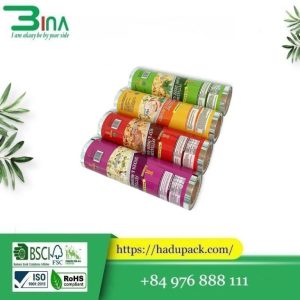
Confectionery packaging is specialized outer packaging material used to protect, preserve, transport, and sell confectionery products. It not only prevents moisture, air, and light from damaging the quality of candy but also attracts consumers through its design and imagery, making it an important tool for brand marketing. Common packaging formats include twist packaging, pillow packaging, and fold packaging, while packaging materials are gradually shifting toward environmentally friendly and recyclable paper.
 |
◆Learn more:
- https://hadupack.com/san-pham/bao-bi-cafe/
- https://hadupack.com/san-pham/bao-bi-tra/
- https://hadupack.com/san-pham/bao-bi-gia-vi/
Main functions and roles of confectionery packaging:
- Physical protection: Isolates candy from oxygen, moisture, and light, preventing it from becoming damp, oxidizing, or melting.
- Brand promotion: Communicates brand values through attractive designs and vibrant colors, attracting customers at the point of sale.
- Hygiene and tamper prevention: Provides a safe and sealed outer environment, ensuring that products reach consumers in a hygienic and reliable condition.
- Information provision: Packaging often displays ingredients, nutritional information, production dates, and expiration dates.
 |
Common types of confectionery packaging:
- Twist packaging: Commonly used for traditional soft candies and milk candies.
- Pillow packaging: The most common and efficient type of automated packaging for fast-moving consumer goods such as chocolate and candy.
- Resealable bags/Zipper bags: Used for sharing candy, making it easy to open and close and store multiple times.
- Folding carton boxes/Cylindrical boxes: Commonly used for gift boxes of premium candy or chocolate.
- Development trends: Currently, candy packaging is undergoing a “plastic reduction” trend, with many brands (such as Nestlé’s Smarties and Quality Street) beginning to use recycled paper or biodegradable materials to produce packaging.
 |
Candy Packaging Production Process
The candy packaging production process mainly includes automated conveying, sorting and forming, packaging material feeding, wrapping/sealing, code printing (date), and inspection. Pillow-type packaging machines, twist-type packaging machines, or automatic packaging machines are commonly used. After rapid cooling, the candies are accurately fed into the packaging machine via a conveyor belt for individual or combined packaging, using sterile composite film to ensure hygiene and shelf life. Detailed candy packaging process:
- Cooling & Forming: Cooked and formed candies need to be rapidly cooled through a cooling tunnel to ensure appropriate hardness and prevent sticking, facilitating subsequent automated packaging.
- Feeding & Sorting: The formed candies are conveyed to the inlet of the packaging machine, where a distribution tray or vibrating conveyor arranges the candies neatly, ensuring that each candy enters the packaging unit in a specific orientation and position.
- Feeding: The paper-feeding system of the packaging machine supplies rolls of composite film (such as OPP/CPP composite film) at a fixed speed to the packaging mechanism for wrapping the candies.
Packaging & Sealing: Common packaging methods include:
- Pillow-type packaging: Paper feeding, forming, sealing, and cutting are completed in one step.
- Twist-type packaging: The wrapping paper is twisted at both ends of the candy.
- Vertical packaging: Suitable for quickly sealing smaller candies.Candy Packaging Production Process
 |
- Coding & Inspection: On the packaging line, automatic inkjet printers typically print the production date, batch number, and other information on the packaging bags. Finally, a machine vision system or metal detector checks whether the finished products have been properly packaged and are free of foreign objects.
- Sorting & Transportation: The packaged finished products are transported to the downstream area for sorting and boxing.
This process relies heavily on highly automated packaging machinery, which not only protects products and facilitates transportation but also significantly improves production efficiency and ensures food hygiene and safety.
 |
Common Problems with Confectionery Packaging
Common problems with confectionery packaging mainly revolve around poor sealing that leads to moisture absorption, incompatibility between packaging materials and candy, printing defects, and short shelf life due to incomplete sealing. Common technical challenges include selecting composite film materials, controlling heat-sealing temperatures, the impact of powdered sugar on seal integrity, and alignment accuracy in high-speed automated packaging lines. Specific common problems are as follows:
 |
1. Sealing Issues and Shelf Life
- Poor sealing: Inadequate sealing of the sealing film or packaging bags allows air and moisture to enter, causing the candy to soften, become sticky, and lose its texture.
- Short shelf life: If the packaging is poorly sealed, the shelf life of candy in high-temperature and high-humidity environments will be significantly shortened (hard and soft candies typically last 6-12 months).
- Moisture absorption: For moisture-sensitive candies such as compressed candies, the poor barrier properties of the packaging can easily lead to moisture absorption, causing crumbling or changes in physical properties.
2. Packaging Materials and Printing Issues
- Different types of materials: Different materials such as polyethylene (PE), polypropylene (PP), and aluminum foil have different surface properties, barrier properties, and heat-sealing temperatures. Improper selection can affect the sealing process.
- Overprinting and coding defects: In high-speed pillow packaging, thermal transfer overprinting (TTO) can lead to defects such as blurred text, wrinkled color bands, and inaccurate positioning.
- Limitations of opaque packaging: Although paper packaging is environmentally friendly, its opacity prevents the candy inside from being displayed directly, sometimes making it less appealing to consumers than transparent film packaging.
 |
3. Technical challenges in the production process
Sugar powder contamination during sealing: Sugar powder or adhesive on the candy surface may adhere to the sealing area during the sealing process, creating air pockets and affecting sealing effectiveness.
Machine adjustment errors: When processing candies of different sizes, incorrect settings for sealing pressure, speed, and temperature may lead to packaging damage or overheating and melting of the sealing layer.
4. Labeling and compliance issues
Nutritional labeling violations: The ingredient list and nutritional information labels on the packaging are unclear or do not match the actual ingredients.
To address these issues, it is generally necessary to select materials with high barrier properties, strictly control the heat-sealing speed, temperature, and pressure of the automated production line, and ensure that the packaging materials are suitable for the characteristics of the candy.